


Page 85 - C:\Users\trainee\AppData\Local\Temp\msoEAA3.tmp
P. 85
Document Title
Fundamentals of Stress and Vibration 2. Engineering Mechanics Chapter
[A Practical guide for aspiring Designers / Analysts]
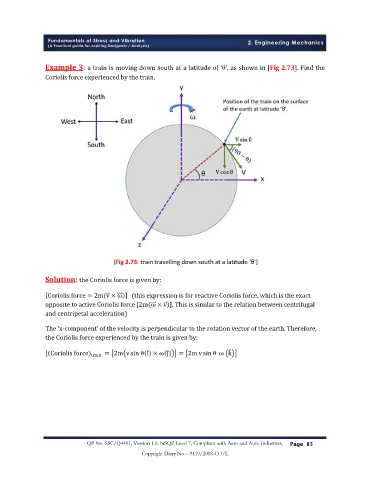
͵ǣ ǮɅǯǡ ȏ ʹǤ͵ȐǤ
Ǥ
[Fig 2.73: train travelling down south at a latitude 'θ']
Solution: the Coriolis force is given by:
Coriolis force = 2m v × ω (this expression is for reactive Coriolis force, which is the exact
opposite to active Coriolis force [2m ω × v ]. This is similar to the relation between centrifugal
and centripetal acceleration)
The ‘x-component’ of the velocity is perpendicular to the rotation vector of the earth. Therefore,
the Coriolis force experienced by the train is given by:
[(Coriolis force) train = 2m vsin θ i × ω j = 2m v sinθ ω k
QP No. SSC/Q4401, Version 1.0, NSQF Level 7, Compliant with Aero and Auto Industries, P
Page 85 age 85
Copyright Diary No – 9119/2018-CO/L

