


Page 81 - C:\Users\trainee\AppData\Local\Temp\msoEAA3.tmp
P. 81
Document Title
                 Fundamentals of Stress and Vibration                              2. Engineering Mechanics   Chapter
                 [A Practical guide for aspiring Designers / Analysts]


                Solution: for a general curve the radius of curvature varies from point to point, as shown in
                [Fig 2.66] and is attributed to the fact that, both slope and the rate of change of slope vary form
                point to point.

                For the ellipse, inspection reveals that, points (A, B, C, D) are the points of maximum and minimum
                radii of curvature. The centripetal acceleration depends on the square of the speed and the radius
                of curvature, and hence, can assume extreme values at (A, B, C, D), given that, the speed is constant.

                Let us evaluate the maximum and minimum curvature/radius and hence the centripetal
                acceleration ratio.


                In order to find the maximum and minimum radius of curvature, let us derive a general equation
                by parameterizing the equation of the ellipse. The equation of the ellipse is given by:

                 x 2  y 2
                   +    = 1
                 a 2  b 2

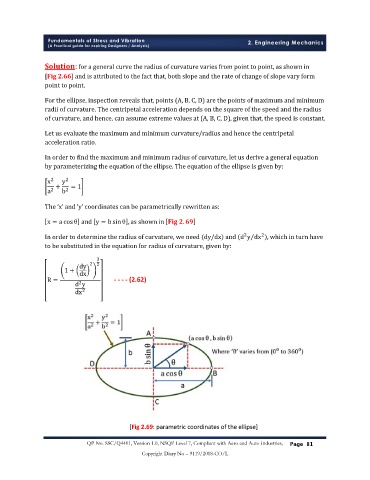
                The ‘x’ and ‘y’ coordinates can be parametrically rewritten as:

                 x = a cos θ  and  y = b sinθ , as shown in           .

                                                                                  2
                                                                                        2
                In order to determine the radius of curvature, we need (dy/dx) and  d y dx  , which in turn have

                to be substituted in the equation for radius of curvature, given by:
                                 3
                           dy  2 2
                      1 +   dx
                  R =                  - - - - (2.62)
                           2
                          d y
                          dx 2


                                            [Fig 2.69: parametric coordinates of the ellipse]


                              QP No. SSC/Q4401, Version 1.0, NSQF Level 7, Compliant with Aero and Auto Industries,   P
                                                                                                 Page 81 age 81
                                                Copyright Diary No – 9119/2018-CO/L

