


Page 82 - C:\Users\trainee\AppData\Local\Temp\msoEAA3.tmp
P. 82
Document Title
                Fundamentals of Stress and Vibration                                  Chapter Title
                [A Practical guide for aspiring Designers / Analysts]              2. Engineering Mechanics


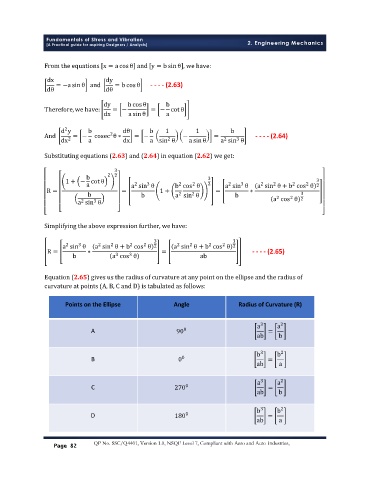
                  From the equations  x = a cosθ  and  y = b sinθ , we have:

                 dx                 dy
                    = −a sinθ   and     = b cos θ   - - - - (2.63)
                 dθ                 dθ

                                   dy      b cos θ      b
                Therefore, we have:    =  −        =  − cot θ
                                   dx       a sin θ     a

                      2
                     d y      b           dθ       b    1         1          b
                                     2
                And      =  −  cosec θ ∗      =  −            −         =             - - - - (2.64)
                                                                               3
                                                                           2
                                                        2
                     dx 2     a           dx       a sin θ      a sinθ    a sin θ
                Substituting equations (2.63) and (2.64) in equation (2.62) we get:
                                       3
                                     2 2
                              b
                        1 +  − cot θ                                  3                                   3
                                                                                       2
                                                                                 3
                                                                 2
                                                  3
                                              2
                                                            2
                                                                             2
                                                                                           2
                                                                                                      2
                                                                                                  2
                              a             a sin θ        b cos θ    2    a sin θ  a sin θ + b cos θ 2
                  R =         b           =     b     1 +   a sin θ      =     b    ∗               3

                                                            2
                                                                2
                                                                                             2
                                                                                                 2
                            a sin θ                                                         a cos θ 2
                            2
                                3


                Simplifying the above expression further, we have:
                                                    3                         3
                                                            2
                                                                2
                           3
                                                                           2
                       2
                                      2
                                            2
                                                 2
                                                                      2
                                  2
                      a sin θ  a sin θ + b cos θ 2         a sin θ + b cos θ 2
                 R =          ∗                        =                            - - - - (2.65)
                                            3
                                       3
                         b            a cos θ                      ab
                Equation (2.65) gives us the radius of curvature at any point on the ellipse and the radius of
                curvature at points (A, B, C and D) is tabulated as follows:

                       Points on the Ellipse               Angle                Radius of Curvature (R)
                                                                                      a 3    a 2
                               A                           90                             =
                                                              0
                                                                                      ab     b
                                                                                      b 3    b 2
                                                             0
                               B                            0                             =
                                                                                      ab     a
                                                                                      a 3    a 2
                               C                           270                            =
                                                              0
                                                                                      ab     b
                                                                                      b 3    b 2
                               D                           180                            =
                                                              0
                                                                                      ab     a

                   Page 82      QP No. SSC/Q4401, Version 1.0, NSQF Level 7, Compliant with Aero and Auto Industries,

