


Page 80 - C:\Users\trainee\AppData\Local\Temp\msoEAA3.tmp
P. 80
Document Title
                Fundamentals of Stress and Vibration                                  Chapter Title
                [A Practical guide for aspiring Designers / Analysts]              2. Engineering Mechanics


                Rearranging the like terms in equation (2.61), we get:

                  2
                          2
                 d r    d r       dr                dω
                                             2


                      =      r  + 2    ωT  − ω rr  +       rT
                 dt 2   dt 2       dt               dt
                The above expression can also be written to get the four accelerations as:
                          2
                                                          2
                  2
                 d r    d r       dr dθ        dθ  2     d θ

                      =      r  + 2                rr  +        rT
                                         T  −
                 dt 2   dt 2       dt dt       dt        dt 2
                In summary the accelerations for curvilinear motion is tabulated as follows:
                 Accelerations               In the form of derivatives   In the form of vectors

                 Radial acceleration                  d r                         d r
                                                        2
                                                                                   2
                                                      dt 2   r                    dt 2   r
                 Coriolis                             dr dθ                     2 ω    × V


                                                   2        T
                                                      dt dt
                 Centripetal acceleration             dθ  2                    ω     ×  ω    × r
                                                          rr
                                                      dt

                                                       2
                 Tangential acceleration             d θ
                                                                                 dω

                                                            rT                      ×  r
                                                      dt 2                       dt

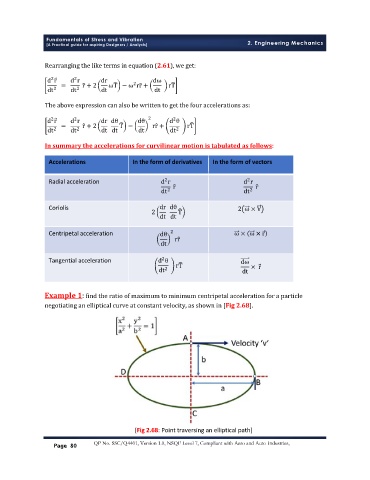
                Example 1: find the ratio of maximum to minimum centripetal acceleration for a particle
                negotiating an elliptical curve at constant velocity, as shown in [Fig 2.68].


                                              [Fig 2.68: Point traversing an elliptical path]

                   Page 80      QP No. SSC/Q4401, Version 1.0, NSQF Level 7, Compliant with Aero and Auto Industries,

