


Page 83 - C:\Users\trainee\AppData\Local\Temp\msoEAA3.tmp
P. 83
Document Title
                 Fundamentals of Stress and Vibration                              2. Engineering Mechanics   Chapter
                 [A Practical guide for aspiring Designers / Analysts]


                Since  we  know  that,  ‘a’  is  greater  than  ‘b’  (‘a’  being  the  major  axis),  the  radius  of  curvature  is
                maximum at ‘B’ and ‘D’ and minimum at ‘A’ and ‘C’.

                Hence, the ratio of minimum and maximum centripetal acceleration given by:

                                                              v 2                 b 2
                         Centripetal acceleration  minimum    R        R max        a     b 2  b    b 3
                                                         =    min    =        =        =    ∗     =
                                                                                   2
                         Centripetal acceleration  maximum     v 2     R min              a   a 2   a 3
                                                                                  a
                                                             R max                b
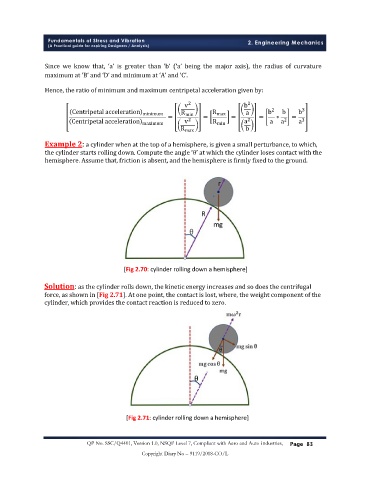
                Example 2: a cylinder when at the top of a hemisphere, is given a small perturbance, to which,
                the cylinder starts rolling down. Compute the angle ‘θ’ at which the cylinder loses contact with the
                hemisphere. Assume that, friction is absent, and the hemisphere is firmly fixed to the ground.


                                          [Fig 2.70: cylinder rolling down a hemisphere]

                Solution: as the cylinder rolls down, the kinetic energy increases and so does the centrifugal
                force, as shown in [Fig 2.71]. At one point, the contact is lost, where, the weight component of the
                cylinder, which provides the contact reaction is reduced to zero.


                                           [Fig 2.71: cylinder rolling down a hemisphere]


                              QP No. SSC/Q4401, Version 1.0, NSQF Level 7, Compliant with Aero and Auto Industries,   Page 83 age 83
                                                                                                 P
                                                Copyright Diary No – 9119/2018-CO/L

