


Page 114 - Fisika Terapan for Engineers and Scientists
P. 114
314                                CHAPTER 10  Systems of Particles


                                                      The position of the center of mass is merely the average position of the mass of the system.
                             For equal-mass particles,
                             the center of mass is at   For instance, if the system consists of two particles, each of mass 1 kg, then the center
                             the average position.
                                                   of mass is halfway between them (see Fig. 10.7). In any system consisting of n parti-
                                                   cles of equal masses—such as a piece of pure metal with atoms of only one kind—the
                                                   x coordinate of the center of mass is simply the sum of the x coordinates of all the par-
                  1 kg        CM         1 kg
                                                   ticles divided by the number of particles,
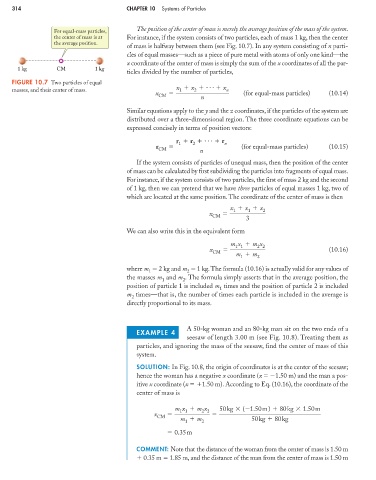
                FIGURE 10.7 Two particles of equal
                masses, and their center of mass.                 x   x       x  n
                                                                       2
                                                                   1

                                                            x                         (for equal-mass particles)  (10.14)

                                                            CM           n
                                                   Similar equations apply to the y and the z coordinates, if the particles of the system are
                                                   distributed over a three-dimensional region. The three coordinate equations can be
                                                   expressed concisely in terms of position vectors:
                                                                  r   r         r n
                                                                       2
                                                                   1
                                                            r                         (for equal-mass particles)  (10.15)
                                                            CM           n
                                                      If the system consists of particles of unequal mass, then the position of the center
                                                   of mass can be calculated by first subdividing the particles into fragments of equal mass.
                                                   For instance, if the system consists of two particles, the first of mass 2 kg and the second
                                                   of 1 kg, then we can pretend that we have three particles of equal masses 1 kg, two of
                                                   which are located at the same position.The coordinate of the center of mass is then
                                                                                  x   x   x 2
                                                                                   1
                                                                                        1
                                                                            x
                                                                             CM
                                                                                       3
                                                   We can also write this in the equivalent form
                                                                                  m x   m x
                                                                                    1 1
                                                                                          2 2
                                                                            x                                   (10.16)
                                                                             CM
                                                                                    m   m
                                                                                     1    2
                                                   where m   2 kg and m   1 kg.The formula (10.16) is actually valid for any values of
                                                         1           2
                                                   the masses m and m . The formula simply asserts that in the average position, the
                                                              1     2
                                                   position of particle 1 is included m times and the position of particle 2 is included
                                                                               1
                                                   m times—that is, the number of times each particle is included in the average is
                                                    2
                                                   directly proportional to its mass.
                                                                     A 50-kg woman and an 80-kg man sit on the two ends of a
                                                      EXAMPLE 4
                                                                     seesaw of length 3.00 m (see Fig. 10.8). Treating them as
                                                      particles, and ignoring the mass of the seesaw, find the center of mass of this
                                                      system.
                                                      SOLUTION: In Fig. 10.8, the origin of coordinates is at the center of the seesaw;
                                                      hence the woman has a negative x coordinate (x   1.50 m) and the man a pos-
                                                      itive x coordinate (x   1.50 m). According to Eq. (10.16), the coordinate of the
                                                      center of mass is

                                                                 m x   m x     50kg   (  1.50m)   80kg   1.50m
                                                                   1 1
                                                                          2 2
                                                             x
                                                            CM
                                                                   m   m                 50kg   80kg
                                                                     1    2
                                                                 0.35m
                                                      COMMENT: Note that the distance of the woman from the center of mass is 1.50 m
                                                        0.35 m   1.85 m, and the distance of the man from the center of mass is 1.50 m

