


Page 115 - Fisika Terapan for Engineers and Scientists
P. 115
10.2  Center of Mass                           315


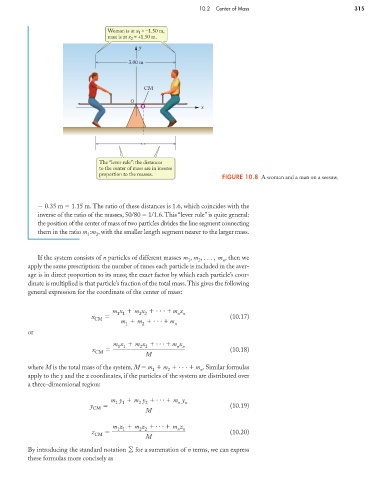
                                             Woman is at x 1  = –1.50 m,
                                             man is at x 2  = +1.50 m.
                                                       y

                                                   3.00 m


                                                        CM
                                                    O
                                                                         x


                                          The “lever rule”: the distances
                                          to the center of mass are in inverse
                                          proportion to the masses.
                                                                                FIGURE 10.8 A woman and a man on a seesaw.


                          0.35 m   1.15 m. The ratio of these distances is 1.6, which coincides with the
                        inverse of the ratio of the masses, 50/80   1/1.6.This “lever rule” is quite general:
                        the position of the center of mass of two particles divides the line segment connecting
                        them in the ratio m :m , with the smaller length segment nearer to the larger mass.
                                       1  2


                        If the system consists of n particles of different masses m , m ,..., m , then we
                                                                     1   2      n
                     apply the same prescription: the number of times each particle is included in the aver-
                     age is in direct proportion to its mass; the exact factor by which each particle’s coor-
                     dinate is multiplied is that particle’s fraction of the total mass.This gives the following
                     general expression for the coordinate of the center of mass:


                                              m x   m x        m x
                                                                  n n
                                                1 1
                                                       2 2
                                        x                                         (10.17)
                                         CM
                                                 m   m        m  n
                                                  1
                                                       2


                     or
                                               m x   m x          m x
                                                       2 2
                                                                  n n
                                                1 1
                                        x                                         (10.18)
                                         CM
                                                        M
                     where M is the total mass of the system, M   m   m    ...    m . Similar formulas
                                                           1   2         n
                     apply to the y and the z coordinates, if the particles of the system are distributed over
                     a three-dimensional region:
                                              m y   m y           m y
                                               1   1
                                                                  n   n
                                                      2   2
                                          y CM                                    (10.19)
                                                        M
                                              m z   m z           m z
                                                1 1
                                                                  n n
                                                       2 2
                                          z CM                                    (10.20)
                                                        M
                     By introducing the standard notation g  for a summation of n terms, we can express
                     these formulas more concisely as

