


Page 116 - Fisika Terapan for Engineers and Scientists
P. 116
316                                CHAPTER 10  Systems of Particles


                                                                                   1  n
                                                                             x       a  m x                     (10.21)
                                                                              CM          i i
                                                                                   M
                                                                                     i 1
                                                                                   1  n
                      coordinates of center of mass                          y CM     a  m y                    (10.22)
                                                                                   M  i 1  i   i


                                                                                    1  n
                                                                             z        a  m z                    (10.23)
                                                                              CM          i i
                         y                                                         M  i 1
                                                      The position of the center of mass of a solid body can, in principle, be calculated
                                                   from Eqs. (10.21)–(10.23), since a solid body is a collection of atoms, each of which
                                                                                                                  23
                                                   can be regarded as a particle. However, it would be awkward to deal with the 10 or
                                                   so atoms that make up a chunk of matter the size of, say, a coin. It is more convenient
                                 m i
                      y i
                                                   to pretend that matter in bulk has a smooth and continuous distribution of mass over
                                                   its entire volume. The mass in some small volume element at position x in the body
                                                                                                            i
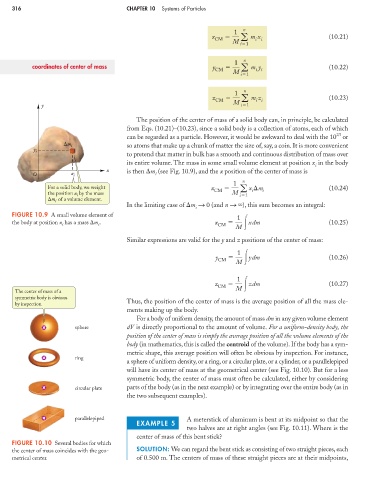
                                             x     is then  m (see Fig. 10.9), and the x position of the center of mass is
                      O           x i                      i
                                                                                      n
                                                                                   1
                           For a solid body, we weight                      x CM     a  x ¢m                    (10.24)
                           the position x by the mass                              M  i 1  i  i
                                    i
                            m of a volume element.
                             i
                                                   In the limiting case of  m S 0 (and n S
), this sum becomes an integral:
                                                                        i
                FIGURE 10.9 A small volume element of                               1
                the body at position x has a mass  m .                        x         x dm                    (10.25)
                               i          i                                   CM
                                                                                    M
                                                   Similar expressions are valid for the y and z positions of the center of mass:
                                                                                    1
                                                                                y       y dm                    (10.26)
                                                                               CM
                                                                                    M
                                                                                    1
                                                                                z       z dm                    (10.27)
                                                                              CM
                 The center of mass of a                                            M
                 symmetric body is obvious
                 by inspection.                    Thus, the position of the center of mass is the average position of all the mass ele-
                                                   ments making up the body.
                                                      For a body of uniform density, the amount of mass dm in any given volume element
                                   sphere          dV is directly proportional to the amount of volume. For a uniform-density body, the
                                                   position of the center of mass is simply the average position of all the volume elements of the
                                                   body (in mathematics, this is called the centroid of the volume). If the body has a sym-
                                                   metric shape, this average position will often be obvious by inspection. For instance,
                                   ring
                                                   a sphere of uniform density, or a ring, or a circular plate, or a cylinder, or a parallelepiped
                                                   will have its center of mass at the geometrical center (see Fig. 10.10). But for a less
                                                   symmetric body, the center of mass must often be calculated, either by considering
                                   circular plate  parts of the body (as in the next example) or by integrating over the entire body (as in
                                                   the two subsequent examples).


                                   parallelepiped                    A meterstick of aluminum is bent at its midpoint so that the
                                                      EXAMPLE 5
                                                                     two halves are at right angles (see Fig. 10.11). Where is the
                                                      center of mass of this bent stick?
                FIGURE 10.10 Several bodies for which
                the center of mass coincides with the geo-  SOLUTION: We can regard the bent stick as consisting of two straight pieces, each
                metrical center.                      of 0.500 m. The centers of mass of these straight pieces are at their midpoints,

