


Page 15 - Fisika Terapan for Engineers and Scientists
P. 15
7.3  Kinetic Energy                           215


                                           dv   dv dx   dv      dv
                                                           v   v                   (7.20)
                                           dt   dx dt   dx      dx
                     Consequently, the work becomes
                                     x 2  dv      x 2  dv       v 2     1  2  v 2
                                  m       dx   m    v    dx   m    v dv   m   v `
                                                                        2
                                     dt            dx
                                                                                   (7.21)
                                   x 1         x 1            v 1           v 1
                                                   1
                                                2
                                            1
                                             mv   mv   2
                                            2   2  2   1
                     or
                                                   1
                                                       2
                                                          1
                                               W   mv   mv   2                     (7.22)
                                                   2   2  2   1
                     This shows that the change in the square of the speed is proportional to the work done
                     by the force.
                        Although we have here obtained the result (7.22) for the simple case of motion
                     along a straight line, it can be shown that the same result is valid for motion along a
                     curve, in three dimensions.
                        According to Eq. (7.22), whenever we perform positive work on the particle, we
                                             2
                                         1
                     increase the “amount of  mv ” in the particle; and whenever we perform negative
                                         2
                     work on the particle (that is, when we let the particle perform work on us), we decrease
                                                                      2
                                     2
                                                                   1
                                  1
                     the “amount of  mv ” in the particle. Thus, the quantity mv is the amount of work
                                                                   2
                                  2
                     stored in the particle, or the kinetic energy of the particle. We represent the kinetic energy
                     by the symbol K:
                                                      1
                                                  K   mv  2                        (7.23)     kinetic energy
                                                      2
                     With this notation, Eq. (7.22) states that the change of kinetic energy equals the net work
                     done on the particle; that is,
                                                 K   K   W                         (7.24)
                                                  2    1
                     or

                                                    K   W                          (7.25)     work–energy theorem


                     This result is called the work–energy theorem. Keep in mind that the work in Eqs.
                     (7.22), (7.24), and (7.25) must be evaluated with the net force; that is, all the forces
                     that do work on the particle must be included in the calculation.
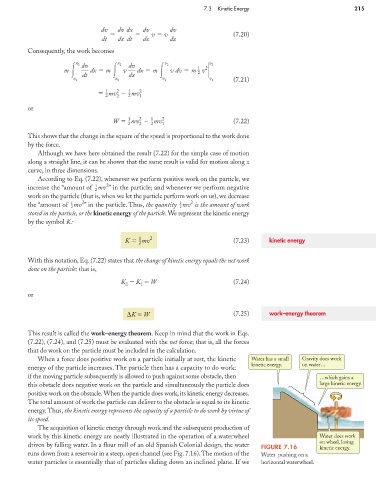
                        When a force does positive work on a particle initially at rest, the kinetic  Water has a small   Gravity does work
                                                                                         kinetic energy.  on water…
                     energy of the particle increases. The particle then has a capacity to do work:
                     if the moving particle subsequently is allowed to push against some obstacle, then      …which gains a
                     this obstacle does negative work on the particle and simultaneously the particle does   large kinetic energy.
                     positive work on the obstacle.When the particle does work, its kinetic energy decreases.
                     The total amount of work the particle can deliver to the obstacle is equal to its kinetic
                     energy.Thus, the kinetic energy represents the capacity of a particle to do work by virtue of
                     its speed.
                        The acquisition of kinetic energy through work and the subsequent production of
                     work by this kinetic energy are neatly illustrated in the operation of a waterwheel     Water does work
                                                                                                             on wheel, losing
                     driven by falling water. In a flour mill of an old Spanish Colonial design, the water  FIGURE 7.16  kinetic energy.
                     runs down from a reservoir in a steep, open channel (see Fig. 7.16).The motion of the  Water pushing on a
                     water particles is essentially that of particles sliding down an inclined plane. If we  horizontal waterwheel.

