


Page 16 - Fisika Terapan for Engineers and Scientists
P. 16
216                                CHAPTER 7  Work and Energy


                                                   ignore friction, then the only force that does work on the water particles is gravity.
                                                   This work is positive, so the kinetic energy of the water increases and it attains a
                                                   maximum value at the lower end of the channel (where its speed is greatest). The
                                                   stream of water emerges from this channel with high kinetic energy and hits the
                                                   blades of the waterwheel. The water pushes on the wheel, turns it, and gives up its
                                                   kinetic energy while doing work—and the wheel runs the millstones and does useful
                                                   work on them. Thus, the work that gravity does on the descending water is ulti-
                                                   mately converted into useful work, with the kinetic energy playing an intermediate
                                                   role in this process.
                                                      The unit of kinetic energy is the joule, the same as the unit of work.Table 7.1 lists
                                                   some typical kinetic energies.


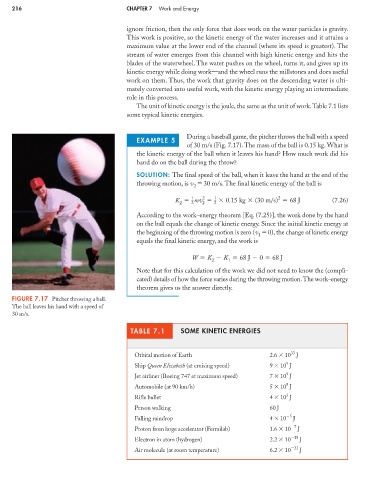
                                                                     During a baseball game, the pitcher throws the ball with a speed
                                                      EXAMPLE 5
                                                                     of 30 m/s (Fig. 7.17).The mass of the ball is 0.15 kg. What is
                                                      the kinetic energy of the ball when it leaves his hand? How much work did his
                                                      hand do on the ball during the throw?
                                                      SOLUTION: The final speed of the ball, when it leave the hand at the end of the
                                                      throwing motion, is v   30 m/s. The final kinetic energy of the ball is
                                                                       2
                                                                             1
                                                                                                 2
                                                                      1
                                                                          2
                                                                 K   mv     0.15 kg   (30 m s)   68 J            (7.26)
                                                                   2  2   2  2
                                                      According to the work–energy theorem [Eq. (7.25)], the work done by the hand
                                                      on the ball equals the change of kinetic energy. Since the initial kinetic energy at
                                                      the beginning of the throwing motion is zero (v   0), the change of kinetic energy
                                                                                           1
                                                      equals the final kinetic energy, and the work is
                                                                       W   K   K   68 J   0   68 J
                                                                             2    1
                                                      Note that for this calculation of the work we did not need to know the (compli-
                                                      cated) details of how the force varies during the throwing motion.The work–energy
                                                      theorem gives us the answer directly.

                FIGURE 7.17 Pitcher throwing a ball.
                The ball leaves his hand with a speed of
                30 m/s.


                                                    TABLE 7.1      SOME KINETIC ENERGIES


                                                                                                     33
                                                     Orbital motion of Earth                  2.6   10 J
                                                                                                   9
                                                     Ship Queen Elizabeth (at cruising speed)  9   10 J
                                                                                                   9
                                                     Jet airliner (Boeing 747 at maximum speed)  7   10 J
                                                                                                   5
                                                     Automobile (at 90 km/h)                  5   10 J
                                                                                                   3
                                                     Rifle bullet                             4   10 J
                                                     Person walking                           60 J
                                                     Falling raindrop                         4   10  5  J
                                                     Proton from large accelerator (Fermilab)  1.6   10  7  J
                                                     Electron in atom (hydrogen)              2.2   10  18  J
                                                     Air molecule (at room temperature)       6.2   10  21  J

