


Page 157 - Fisika Terapan for Engineers and Scientists
P. 157
Problems                              357


                         and the initially stationary mass (target) is 120 g. The initial  are elastic and head-on. What is the recoil kinetic energy of the
                         velocity of the projectile is 0.80 m s.              alpha particle when the target is (a) silicon (m   28 u) and
                         (a) What is the velocity of each mass after the collision?  (b) copper (m   63 u)?
                         (b) What is the kinetic energy of each mass before the colli-  *27. An automobile traveling at 60 km h bumps into the rear of
                            sion? After the collision?                        another automobile traveling at 55 km h in the same direction.
                                                                              The mass of the first automobile is 1200 kg, and the mass of the
                      18. A target sometimes used for target shooting with small bullets
                                                                              second automobile is 1000 kg. If the collision is elastic, find the
                         consists of a steel disk hanging on a rod which is free to swing
                                                                              velocities of both automobiles immediately after this collision.
                         on a pivot (in essence, a pendulum). The collision of the bullet
                                                                              (Hint: Solve this problem in a reference frame moving with a
                         with the steel disk is not elastic and not totally inelastic, but
                                                                              velocity equal to the initial velocity of one of the automobiles.)
                         somewhere between these extremes. Suppose that a .22-caliber
                         bullet of 15 g and initial speed 600 m s strikes such a target of  *28. A projectile of 45 kg has a muzzle speed of 656.6 m s when
                         mass 40 g. With what velocity would this bullet bounce back  fired horizontally from a gun held in a rigid support (no recoil).
                         (ricochet) if the collision were elastic? Assume that the disk  What will be the muzzle speed (relative to the ground) of the
                         acts like a free particle during the collision.      same projectile when fired from a gun that is free to recoil? The
                                                                                                 3
                                                                              mass of the gun is 6.6   10 kg. (Hint: The kinetic energy of
                      19. The impact of the head of a golf club on a golf ball can be
                                                                              the gun–projectile system is the same in both cases.)
                         approximately regarded as an elastic collision. The mass of the
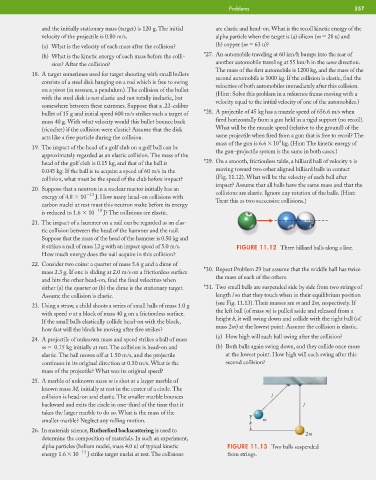
                         head of the golf club is 0.15 kg, and that of the ball is  *29. On a smooth, frictionless table, a billiard ball of velocity v is
                         0.045 kg. If the ball is to acquire a speed of 60 m s in the  moving toward two other aligned billiard balls in contact
                         collision, what must be the speed of the club before impact?  (Fig. 11.12). What will be the velocity of each ball after
                                                                              impact? Assume that all balls have the same mass and that the
                      20. Suppose that a neutron in a nuclear reactor initially has an  collisions are elastic. Ignore any rotation of the balls. (Hint:
                         energy of 4.8   10  13  J. How many head-on collisions with
                                                                              Treat this as two successive collisions.)
                         carbon nuclei at rest must this neutron make before its energy
                         is reduced to 1.6   10  19  J? The collisions are elastic.
                      21. The impact of a hammer on a nail can be regarded as an elas-
                         tic collision between the head of the hammer and the nail.
                         Suppose that the mass of the head of the hammer is 0.50 kg and
                         it strikes a nail of mass 12 g with an impact speed of 5.0 m s.  FIGURE 11.12 Three billiard balls along a line.
                         How much energy does the nail acquire in this collision?
                      22. Consider two coins: a quarter of mass 5.6 g and a dime of
                                                                          *30. Repeat Problem 29 but assume that the middle ball has twice
                         mass 2.3 g. If one is sliding at 2.0 m s on a frictionless surface
                                                                              the mass of each of the others.
                         and hits the other head-on, find the final velocities when
                         either (a) the quarter or (b) the dime is the stationary target.  *31. Two small balls are suspended side by side from two strings of
                         Assume the collision is elastic.                     length l so that they touch when in their equilibrium position
                                                                              (see Fig. 11.13). Their masses are m and 2m, respectively. If
                      23. Using a straw, a child shoots a series of small balls of mass 1.0 g
                                                                              the left ball (of mass m) is pulled aside and released from a
                         with speed v at a block of mass 40 g on a frictionless surface.
                                                                              height h, it will swing down and collide with the right ball (of
                         If the small balls elastically collide head-on with the block,
                                                                              mass 2m) at the lowest point. Assume the collision is elastic.
                         how fast will the block be moving after five strikes?
                                                                              (a) How high will each ball swing after the collision?
                      24. A projectile of unknown mass and speed strikes a ball of mass
                         m   0.15 kg initially at rest. The collision is head-on and  (b) Both balls again swing down, and they collide once more
                         elastic. The ball moves off at 1.50 m s, and the projectile  at the lowest point. How high will each swing after this
                         continues in its original direction at 0.50 m s. What is the  second collision?
                         mass of the projectile? What was its original speed?
                      25. A marble of unknown mass m is shot at a larger marble of
                         known mass M, initially at rest in the center of a circle. The
                         collision is head-on and elastic. The smaller marble bounces          l
                         backward and exits the circle in one-third of the time that it                 l
                         takes the larger marble to do so. What is the mass of the
                         smaller marble? Neglect any rolling motion.                    h   m
                      26. In materials science, Rutherford backscattering is used to
                                                                                                         2m
                         determine the composition of materials. In such an experiment,
                         alpha particles (helium nuclei, mass 4.0 u) of typical kinetic  FIGURE 11.13 Two balls suspended
                         energy 1.6   10  13  J strike target nuclei at rest.The collisions  from strings.

