


Page 166 - Fisika Terapan for Engineers and Scientists
P. 166
366                                CHAPTER 12  Rotation of a Rigid Body


                                                       body is rigid if the particles in the body do not move relative to one another. Thus, the
                                     rigid body
                                                   Abody has a fixed shape, and all its parts have a fixed position relative to one another.
                                                   A hammer is a rigid body, and so is a baseball bat. A baseball is not rigid—when struck
                                                   a blow by the bat, the ball suffers a substantial deformation; that is, different parts of
                                                   the ball move relative to one another. However, the baseball can be regarded as a rigid
                                                   body while it flies through the air—the air resistance is not sufficiently large to pro-
                                                   duce an appreciable deformation of the ball. This example indicates that whether a
                                                   body can be regarded as rigid depends on the circumstances. No body is absolutely
                                                   rigid; when subjected to a sufficiently large force, any body will suffer some deforma-
                                                   tion or perhaps even break into several pieces. In this chapter, we will ignore such
                                                   deformations produced by the forces acting on bodies. We will examine the motion
                                                   of bodies under the assumption that rigidity is a good approximation.


                                                   12.1 MOTION OF A RIGID BODY


                                                   A rigid body can simultaneously have two kinds of motion: it can change its position
                                                   in space, and it can change its orientation in space. Change of position is translational
                                                   motion; as we saw in Chapter 10, this motion can be conveniently described as motion
                       Hammer rotates              of the center of mass. Change in orientation is rotational motion; that is, it is rotation
                       about its center
                       of mass.                    about some axis.
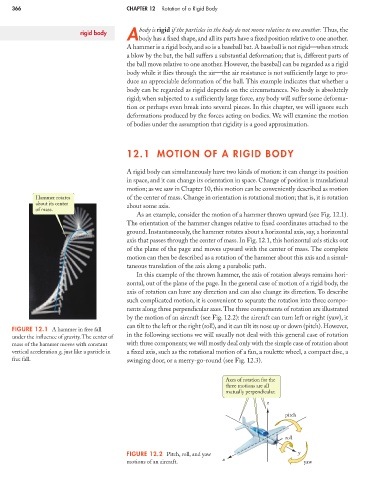
                                                      As an example, consider the motion of a hammer thrown upward (see Fig. 12.1).
                                                   The orientation of the hammer changes relative to fixed coordinates attached to the
                                                   ground. Instantaneously, the hammer rotates about a horizontal axis, say, a horizontal
                                                   axis that passes through the center of mass. In Fig. 12.1, this horizontal axis sticks out
                                                   of the plane of the page and moves upward with the center of mass. The complete
                                                   motion can then be described as a rotation of the hammer about this axis and a simul-
                                                   taneous translation of the axis along a parabolic path.
                                                      In this example of the thrown hammer, the axis of rotation always remains hori-
                                                   zontal, out of the plane of the page. In the general case of motion of a rigid body, the
                                                   axis of rotation can have any direction and can also change its direction. To describe
                                                   such complicated motion, it is convenient to separate the rotation into three compo-
                                                   nents along three perpendicular axes.The three components of rotation are illustrated
                                                   by the motion of an aircraft (see Fig. 12.2): the aircraft can turn left or right (yaw), it
                                                   can tilt to the left or the right (roll), and it can tilt its nose up or down (pitch). However,
                FIGURE 12.1 A hammer in free fall
                under the influence of gravity. The center of  in the following sections we will usually not deal with this general case of rotation
                mass of the hammer moves with constant  with three components; we will mostly deal only with the simple case of rotation about
                vertical acceleration g, just like a particle in  a fixed axis, such as the rotational motion of a fan, a roulette wheel, a compact disc, a
                free fall.                         swinging door, or a merry-go-round (see Fig. 12.3).


                                                                                 Axes of rotation for the
                                                                                 three motions are all
                                                                                 mutually perpendicular.
                                                                                             z

                                                                                                   pitch


                                                                                                   roll

                                                   FIGURE 12.2 Pitch, roll, and yaw                    y
                                                                                x
                                                   motions of an aircraft.                               yaw

