


Page 163 - Fisika Terapan for Engineers and Scientists
P. 163
Answers to Checkups                           363


                         (b) How much kinetic energy was released for inelastic  vertical and then let it go, it will collide elastically with the
                            processes during the collision? Express this energy in the  other ball. How high will the other ball rise?
                            equivalent of tons of TNT; 1 ton of TNT releases 4.2    (b) Suppose that instead of steel balls we use putty balls. They
                              9
                            10 J upon explosion.                                 will then collide inelastically and remain stuck together.
                         (c) Estimate the magnitude of the impulsive force.      How high will the balls rise?
                     *78. A black automobile smashes into the rear of a white automo-  *80. While in flight, a peregrine falcon spots a pigeon flying 40 m
                         bile stopped at a stop sign. You investigate this collision and  below. The falcon closes its wings and, in free fall, dives on the
                         find that before the collision, the black automobile made skid  pigeon and grabs it (a totally inelastic collision). The mass of
                         marks 5.0 m long; after the collision the black automobile  the falcon is 1.5 kg, and the mass of the pigeon is 0.40 kg.
                         made skid marks 1.0 m long (in the same direction as the ini-  Suppose that the velocity of the pigeon before this collision is
                         tial direction of motion), and the white automobile made skid  horizontal, at 15 m/s, and the velocity of the falcon is vertical,
                         marks 2.0 m long. Both automobiles made these skid marks  equal to the free-fall velocity. What is the velocity (magnitude
                         with all their wheels. The mass of the black automobile is  and direction) of both birds after the collision?
                         1400 kg, and the mass of the white automobile is 800 kg. The  *81. On a freeway, a truck of 3500 kg collides with an automobile
                         coefficient of sliding friction between the wheels and the  of 1500 kg that is trying to cut diagonally across the path of
                         pavement is 0.90. From these data, deduce the speed of the  the truck. Just before the collision, the truck was traveling due
                         black automobile just before the collision, and the speed  north at 70 km h, and the automobile was traveling at 30
                         before it started to brake.                          west of north at 100 km h. After the collision, the vehicles
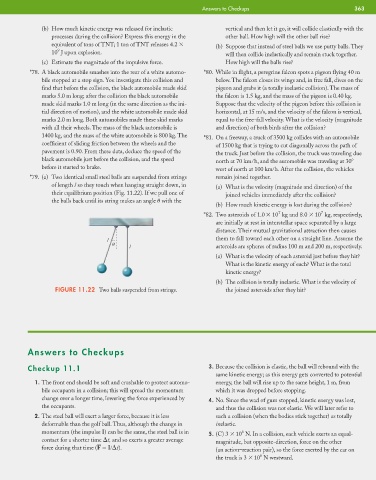
                     *79. (a) Two identical small steel balls are suspended from strings  remain joined together.
                            of length l so they touch when hanging straight down, in  (a) What is the velocity (magnitude and direction) of the
                            their equilibrium position (Fig. 11.22). If we pull one of  joined vehicles immediately after the collision?
                            the balls back until its string makes an angle   with the
                                                                              (b) How much kinetic energy is lost during the collision?
                                                                                                              7
                                                                                                 7
                                                                          *82. Two asteroids of 1.0   10 kg and 8.0   10 kg, respectively,
                                                                              are initially at rest in interstellar space separated by a large
                                                                              distance. Their mutual gravitational attraction then causes
                                             l                                them to fall toward each other on a straight line. Assume the
                                              u
                                                    l                         asteroids are spheres of radius 100 m and 200 m, respectively.
                                                                              (a) What is the velocity of each asteroid just before they hit?
                                                                                 What is the kinetic energy of each? What is the total
                                                                                 kinetic energy?
                                                                              (b) The collision is totally inelastic. What is the velocity of
                             FIGURE 11.22 Two balls suspended from strings.      the joined asteroids after they hit?


                     Answers to Checkups

                     Checkup 11.1                                           3. Because the collision is elastic, the ball will rebound with the
                                                                              same kinetic energy; as this energy gets converted to potential
                       1. The front end should be soft and crushable to protect automo-  energy, the ball will rise up to the same height, 1 m, from
                         bile occupants in a collision; this will spread the momentum  which it was dropped before stopping.
                         change over a longer time, lowering the force experienced by  4. No. Since the wad of gum stopped, kinetic energy was lost,
                         the occupants.                                       and thus the collision was not elastic. We will later refer to
                       2. The steel ball will exert a larger force, because it is less  such a collision (when the bodies stick together) as totally
                         deformable than the golf ball. Thus, although the change in  inelastic.
                         momentum (the impulse I) can be the same, the steel ball is in  5. (C) 3   10 N. In a collision, each vehicle exerts an equal-
                                                                                      6
                         contact for a shorter time  t, and so exerts a greater average  magnitude, but opposite-direction, force on the other
                         force during that time (   I  t).F                   (an action–reaction pair), so the force exerted by the car on
                                                                                           6
                                                                              the truck is 3   10 N westward.

