


Page 162 - Fisika Terapan for Engineers and Scientists
P. 162
362                                CHAPTER 11  Collisions


                REVIEW PROBLEMS


                 67. High-speed photography reveals that when a golf club hits a  *73. A boy throws a baseball at another baseball sitting on a 1.5-m-
                    golf ball, the club and the ball typically remain in contact for  high fence. The collision of the balls is elastic. The thrown ball
                    1.0   10  3  s and the ball acquires a speed of 70 m s. The mass  moves horizontally at 20 m s just before the head-on collision.
                    of the ball is 45 g. What is the impulse the club delivers to the  (a) What are the velocities of the two balls just after the
                    ball? What is the time-average force?                   collision?
                 68. In a remarkable incident, a 52-kg woman jumped from the  (b) Where do the two balls land on the ground?
                    10th floor of an apartment building, fell 28 m, and landed on
                                                                      74. An automobile of 1200 kg traveling at 45 km h strikes a
                    her side on soft earth in a freshly dug garden. She fractured
                                                                         moose of 400 kg standing on the road. Assume that the colli-
                    her wrist and rib, but remained conscious and fully alert, and
                                                                         sion is totally inelastic (the moose remains draped over the
                    recovered completely after some time in a hospital. The earth
                                                                         front end of the automobile). What is the speed of the auto-
                    was depressed 15 cm by her impact.
                                                                         mobile immediately after this collision?
                    (a) What was her impact speed?                                    4
                                                                      75. A ship of 3.0   10 metric tons steaming at 40 km h strikes
                    (b) Assuming constant deceleration upon contact with the  an iceberg of 8.0 10 metric tons. If the collision is totally
                                                                                         5
                       ground, what was her deceleration?                inelastic, what fraction of the initial kinetic energy of the ship
                    (c) What was the force of the ground on her body during  is converted into inelastic energy? What fraction remains as
                       deceleration?                                     kinetic energy of the ship–iceberg system? Ignore the effect of
                 69. An automobile approaching an intersection at 10 km h bumps  the water on the motion of the ship and iceberg.
                    into the rear of another automobile standing at the intersec-  *76. When William Tell shot the apple off his son’s head, the arrow
                    tion with its brakes off and its gears in neutral. The mass of  remained stuck in the apple, which means the collision
                    the moving automobile is 1200 kg, and that of the stationary  between the arrow and apple was totally inelastic. Suppose
                    automobile is 700 kg. If the collision is elastic, find the veloci-  that the velocity of the arrow was horizontal at 80 m s before
                    ties of both automobiles after the collision.        it hit, the mass of the arrow was 40 g, and the mass of the
                 70. It has been reported (fallaciously) that the deer botfly can  apple was 200 g. Suppose Tell’s son was 1.40 m high.
                    attain a maximum airspeed of 1318 km h, that is, 366 m s.  (a) Calculate the velocity of the apple and arrow immediately
                    Suppose that such a fly, buzzing along at this speed, strikes a  after the collision.
                    stationary hummingbird and remains stuck in it. What will be  (b) Calculate how far behind the son the apple and arrow
                    the recoil velocity of the hummingbird? The mass of the fly is  landed on the ground.
                    2 g; the mass of the hummingbird is 50 g.
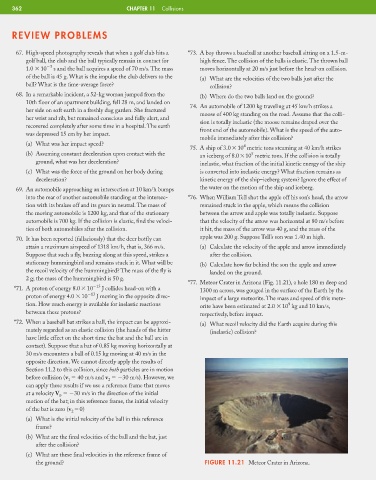
                                                                     *77. Meteor Crater in Arizona (Fig. 11.21), a hole 180 m deep and
                 *71. A proton of energy 8.0   10  13  J collides head-on with a  1300 m across, was gouged in the surface of the Earth by the
                    proton of energy 4.0   10  13  J moving in the opposite direc-  impact of a large meteorite. The mass and speed of this mete-
                    tion. How much energy is available for inelastic reactions  orite have been estimated at 2.0   10 kg and 10 km s,
                                                                                                    9
                    between these protons?                               respectively, before impact.
                 *72. When a baseball bat strikes a ball, the impact can be approxi-  (a) What recoil velocity did the Earth acquire during this
                    mately regarded as an elastic collision (the hands of the hitter  (inelastic) collision?
                    have little effect on the short time the bat and the ball are in
                    contact). Suppose that a bat of 0.85 kg moving horizontally at
                    30 m s encounters a ball of 0.15 kg moving at 40 m s in the
                    opposite direction. We cannot directly apply the results of
                    Section 11.2 to this collision, since both particles are in motion
                    before collision (v   40 m s and v    30 m s). However, we
                                 1           2
                    can apply these results if we use a reference frame that moves
                    at a velocity V    30 m s in the direction of the initial
                              0
                    motion of the bat; in this reference frame, the initial velocity
                    of the bat is zero (v  0)
                                  2
                    (a) What is the initial velocity of the ball in this reference
                       frame?
                    (b) What are the final velocities of the ball and the bat, just
                       after the collision?
                    (c) What are these final velocities in the reference frame of
                       the ground?                                         FIGURE 11.21 Meteor Crater in Arizona.

