


Page 170 - Fisika Terapan for Engineers and Scientists
P. 170
370                                CHAPTER 12  Rotation of a Rigid Body


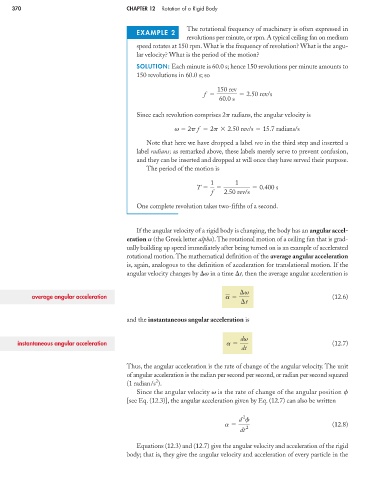
                                                                     The rotational frequency of machinery is often expressed in
                                                      EXAMPLE 2
                                                                     revolutions per minute, or rpm. A typical ceiling fan on medium
                                                      speed rotates at 150 rpm. What is the frequency of revolution? What is the angu-
                                                      lar velocity? What is the period of the motion?

                                                      SOLUTION: Each minute is 60.0 s; hence 150 revolutions per minute amounts to
                                                      150 revolutions in 60.0 s; so

                                                                              150 rev
                                                                          f            2.50 rev/s
                                                                               60.0 s

                                                      Since each revolution comprises 2  radians, the angular velocity is
                                                                     2p f    2p   2.50 rev/s   15.7 radians/s

                                                         Note that here we have dropped a label rev in the third step and inserted a
                                                      label radians; as remarked above, these labels merely serve to prevent confusion,
                                                      and they can be inserted and dropped at will once they have served their purpose.
                                                         The period of the motion is

                                                                            1       1
                                                                        T                  0.400 s
                                                                            f   2.50 rev/s
                                                      One complete revolution takes two-fifths of a second.


                                                      If the angular velocity of a rigid body is changing, the body has an angular accel-
                                                   eration   (the Greek letter alpha).The rotational motion of a ceiling fan that is grad-
                                                   ually building up speed immediately after being turned on is an example of accelerated
                                                   rotational motion. The mathematical definition of the average angular acceleration
                                                   is, again, analogous to the definition of acceleration for translational motion. If the
                                                   angular velocity changes by    in a time  t, then the average angular acceleration is

                                                                                     ¢
                      average angular acceleration                                                               (12.6)
                                                                                     ¢t


                                                   and the instantaneous angular acceleration is

                                                                                     d
                  instantaneous angular acceleration                                                             (12.7)
                                                                                      dt

                                                   Thus, the angular acceleration is the rate of change of the angular velocity. The unit
                                                   of angular acceleration is the radian per second per second, or radian per second squared
                                                            2
                                                   (1 radian/s ).
                                                      Since the angular velocity   is the rate of change of the angular position
                                                   [see Eq. (12.3)], the angular acceleration given by Eq. (12.7) can also be written

                                                                                      2
                                                                                     d f
                                                                                                                 (12.8)
                                                                                     dt 2
                                                      Equations (12.3) and (12.7) give the angular velocity and acceleration of the rigid
                                                   body; that is, they give the angular velocity and acceleration of every particle in the

