


Page 171 - Fisika Terapan for Engineers and Scientists
P. 171
12.2  Rotation about a Fixed Axis                       371


                     body. It is interesting to focus on one of the particles and evaluate its translational  y
                     speed and acceleration as it moves along its circular path around the axis of rotation of
                                                                                                         v
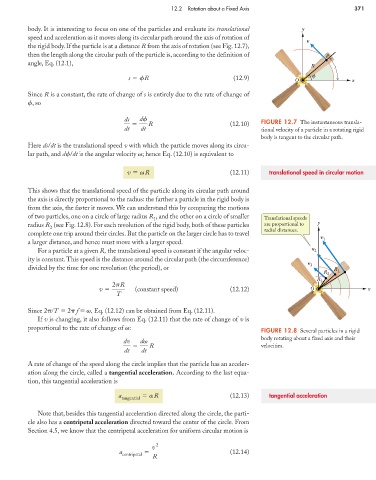
                     the rigid body. If the particle is at a distance R from the axis of rotation (see Fig. 12.7),
                     then the length along the circular path of the particle is, according to the definition of  P
                     angle, Eq. (12.1),
                                                                                                           R      s
                                                   s   fR                          (12.9)             O                x

                     Since R is a constant, the rate of change of s is entirely due to the rate of change of
                      ,so


                                                  ds   df
                                                         R                        (12.10)   FIGURE 12.7 The instantaneous transla-
                                                  dt   dt                                   tional velocity of a particle in a rotating rigid
                                                                                            body is tangent to the circular path.
                     Here ds/dt is the translational speed v with which the particle moves along its circu-
                     lar path, and d /dt is the angular velocity  ; hence Eq. (12.10) is equivalent to


                                                   v    R                         (12.11)     translational speed in circular motion

                     This shows that the translational speed of the particle along its circular path around
                     the axis is directly proportional to the radius: the farther a particle in the rigid body is
                     from the axis, the faster it moves. We can understand this by comparing the motions
                     of two particles, one on a circle of large radius R , and the other on a circle of smaller
                                                           1                                 Translational speeds
                     radius R (see Fig. 12.8). For each revolution of the rigid body, both of these particles  are proportional to   y
                           2
                     complete one trip around their circles. But the particle on the larger circle has to travel  radial distances.
                                                                                                              v 1
                     a larger distance, and hence must move with a larger speed.
                        For a particle at a given R, the translational speed is constant if the angular veloc-  v 2
                     ity is constant.This speed is the distance around the circular path (the circumference)
                                                                                                          v 3
                     divided by the time for one revolution (the period), or
                                                                                                               R 2  R 1
                                                                                                             R R 3 3
                                              2pR
                                          v             (constant speed)          (12.12)                  O                x
                                                T

                     Since 2  T   2  f    , Eq. (12.12) can be obtained from Eq. (12.11).
                        If v is changing, it also follows from Eq. (12.11) that the rate of change of v is
                     proportional to the rate of change of  :
                                                                                            FIGURE 12.8 Several particles in a rigid
                                                  dv   d                                    body rotating about a fixed axis and their
                                                          R                                 velocities.
                                                  dt   dt
                     A rate of change of the speed along the circle implies that the particle has an acceler-
                     ation along the circle, called a tangential acceleration. According to the last equa-
                     tion, this tangential acceleration is

                                                a         R                       (12.13)     tangential acceleration
                                                 tangential
                        Note that, besides this tangential acceleration directed along the circle, the parti-
                     cle also has a centripetal acceleration directed toward the center of the circle. From
                     Section 4.5, we know that the centripetal acceleration for uniform circular motion is

                                                            2
                                                          v
                                                 a                                (12.14)
                                                 centripetal
                                                           R

