


Page 161 - Fisika Terapan for Engineers and Scientists
P. 161
Problems                              361


                     *60. On July 27, 1956, the ships Andrea Doria (40000 metric tons)
                         and Stockholm (20000 metric tons) collided in the fog south
                         of Nantucket and remained locked together (for a while).
                         Immediately before the collision the velocity of the Andrea Doria
                         was 22 knots at 15  east of south and that of the Stockholm was
                         19 knots at 48  east of south (1 knot 1 nmi h 1.85 km h).
                         (a) Calculate the velocity (magnitude and direction) of the
                            combined wreck immediately after the collision.                                     b
                         (b) Find the amount of kinetic energy that was converted into
                            other forms of energy by inelastic processes during the
                            collision.
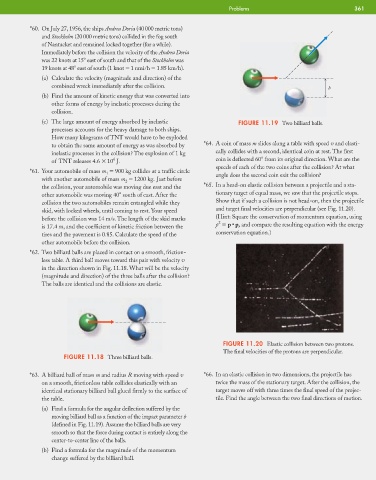
                         (c) The large amount of energy absorbed by inelastic        FIGURE 11.19 Two billiard balls.
                            processes accounts for the heavy damage to both ships.
                            How many kilograms of TNT would have to be exploded
                            to obtain the same amount of energy as was absorbed by  *64. A coin of mass m slides along a table with speed v and elasti-
                            inelastic processes in the collision? The explosion of 1 kg  cally collides with a second, identical coin at rest. The first
                                               6
                            of TNT releases 4.6   10 J.                       coin is deflected 60  from its original direction. What are the
                                                                              speeds of each of the two coins after the collision? At what
                     *61. Your automobile of mass m   900 kg collides at a traffic circle  angle does the second coin exit the collision?
                                             1
                         with another automobile of mass m   1200 kg. Just before
                                                  2
                         the collision, your automobile was moving due east and the  *65. In a head-on elastic collision between a projectile and a sta-
                         other automobile was moving 40  south of east. After the  tionary target of equal mass, we saw that the projectile stops.
                         collision the two automobiles remain entangled while they  Show that if such a collision is not head-on, then the projectile
                         skid, with locked wheels, until coming to rest. Your speed  and target final velocities are perpendicular (see Fig. 11.20).
                         before the collision was 14 m s. The length of the skid marks  (Hint: Square the conservation of momentum equation, using
                                                                               2
                         is 17.4 m, and the coefficient of kinetic friction between the  p   p • p, and compare the resulting equation with the energy
                         tires and the pavement is 0.85. Calculate the speed of the  conservation equation.)
                         other automobile before the collision.
                     *62. Two billiard balls are placed in contact on a smooth, friction-
                         less table. A third ball moves toward this pair with velocity v
                         in the direction shown in Fig. 11.18. What will be the velocity
                         (magnitude and direction) of the three balls after the collision?
                         The balls are identical and the collisions are elastic.


                                                                                FIGURE 11.20 Elastic collision between two protons.
                                                                                The final velocities of the protons are perpendicular.
                                FIGURE 11.18 Three billiard balls.

                     *63. A billiard ball of mass m and radius R moving with speed v  *66. In an elastic collision in two dimensions, the projectile has
                         on a smooth, frictionless table collides elastically with an  twice the mass of the stationary target. After the collision, the
                         identical stationary billiard ball glued firmly to the surface of  target moves off with three times the final speed of the projec-
                         the table.                                           tile. Find the angle between the two final directions of motion.
                         (a) Find a formula for the angular deflection suffered by the
                            moving billiard ball as a function of the impact parameter b
                            (defined in Fig. 11.19). Assume the billiard balls are very
                            smooth so that the force during contact is entirely along the
                            center-to-center line of the balls.
                         (b) Find a formula for the magnitude of the momentum
                            change suffered by the billiard ball.

