


Page 167 - Fisika Terapan for Engineers and Scientists
P. 167
12.2  Rotation about a Fixed Axis                       367


                       (a)                               (b)                   (c)                   (d)


                                                                                         (e)
                      ✔      Checkup 12.1


                     QUESTION 1: Characterize the following motions as translational, rotational, or both:
                     swinging motion of door, motion of wheel of train, motion of propeller of airplane
                     while in level flight.
                     QUESTION 2: Suppose that instead of selecting an axis through the center of mass of
                     the hammer in Fig. 12.1, we select a parallel axis through the end of the handle. Can
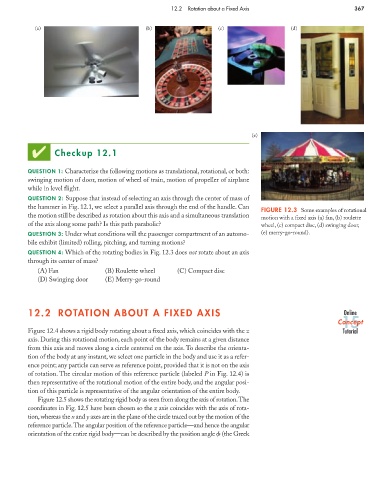
                                                                                            FIGURE 12.3 Some examples of rotational
                     the motion still be described as rotation about this axis and a simultaneous translation  motion with a fixed axis (a) fan, (b) roulette
                     of the axis along some path? Is this path parabolic?                   wheel, (c) compact disc, (d) swinging door,
                     QUESTION 3: Under what conditions will the passenger compartment of an automo-  (e) merry-go-round).
                     bile exhibit (limited) rolling, pitching, and turning motions?
                     QUESTION 4: Which of the rotating bodies in Fig. 12.3 does not rotate about an axis
                     through its center of mass?
                        (A) Fan             (B) Roulette wheel    (C) Compact disc
                        (D) Swinging door   (E) Merry-go-round


                     12.2 ROTATION ABOUT A FIXED AXIS                                                                Online
                                                                                                                    15
                                                                                                                   Concept
                     Figure 12.4 shows a rigid body rotating about a fixed axis, which coincides with the z         Tutorial
                     axis. During this rotational motion, each point of the body remains at a given distance
                     from this axis and moves along a circle centered on the axis. To describe the orienta-
                     tion of the body at any instant, we select one particle in the body and use it as a refer-
                     ence point; any particle can serve as reference point, provided that it is not on the axis
                     of rotation. The circular motion of this reference particle (labeled P in Fig. 12.4) is
                     then representative of the rotational motion of the entire body, and the angular posi-
                     tion of this particle is representative of the angular orientation of the entire body.
                        Figure 12.5 shows the rotating rigid body as seen from along the axis of rotation.The
                     coordinates in Fig. 12.5 have been chosen so the z axis coincides with the axis of rota-
                     tion,whereas the x and y axes are in the plane of the circle traced out by the motion of the
                     reference particle.The angular position of the reference particle—and hence the angular
                     orientation of the entire rigid body—can be described by the position angle   (the Greek

