


Page 172 - Fisika Terapan for Engineers and Scientists
P. 172
372                                CHAPTER 12  Rotation of a Rigid Body


                                                   With v    R, this becomes
                                                                                         2
                           centripetal acceleration                           a          R                      (12.15)
                                                                               centripetal
                                                      The net translational acceleration of the particle is the vector sum of the tangen-
                                                   tial and the centripetal accelerations, which are perpendicular (see Fig. 12.9); thus, the
                     Centripetal and tangential
                     accelerations are perpendicular.  magnitude of the net acceleration is
                         y
                                                                                 2         2
                                                                        a                                       (12.16)
                                                                         net    2a  tangential  	 a  centripetal
                            a tan
                                                      Although we have here introduced the concept of tangential acceleration in the
                          a net  P
                                                   context of the rotational motion of a rigid body, this concept is also applicable to the
                             a cent
                                                   translational motion of a particle along a circular path or any curved path. For instance,
                       O                x          consider an automobile (regarded as a particle) traveling around a curve. If the driver
                                                   steps on the accelerator (or on the brake), the automobile will suffer a change of speed
                                                   as it travels around the curve. It will then have both a tangential and a centripetal
                                                   acceleration.

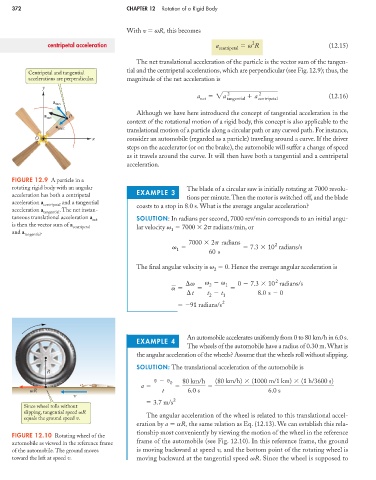
                FIGURE 12.9 A particle in a
                rotating rigid body with an angular                  The blade of a circular saw is initially rotating at 7000 revolu-
                acceleration has both a centripetal   EXAMPLE 3
                                                                     tions per minute.Then the motor is switched off, and the blade
                acceleration a centripetal  and a tangential
                acceleration a  . The net instan-     coasts to a stop in 8.0 s. What is the average angular acceleration?
                          tangential
                taneous translational acceleration a net  SOLUTION: In radians per second, 7000 rev/min corresponds to an initial angu-
                is then the vector sum of a centripetal  lar velocity     7000   2  radians min, or
                and a tangential .                              1
                                                                      7000   2p radians
                                                                                                2
                                                                                        7.3   10  radians/s
                                                                  1
                                                                            60 s
                                                      The final angular velocity is     0. Hence the average angular acceleration is
                                                                             2
                                                                                                2
                                                                     ¢           1   0   7.3   10  radians/s
                                                                            2

                                                                     ¢t    t   t           8.0 s   0
                                                                            2   1
                                                                     91 radians/s 2


                                                                     An automobile accelerates uniformly from 0 to 80 km/h in 6.0 s.
                                                      EXAMPLE 4
                                                                     The wheels of the automobile have a radius of 0.30 m. What is
                                                      the angular acceleration of the wheels? Assume that the wheels roll without slipping.
                                                      SOLUTION: The translational acceleration of the automobile is
                          R
                                                           v   v 0  80 km/h   (80 km/h)   (1000 m/1 km)   (1 h/3600 s)
                                                         a
                      R                                       t      6.0 s                    6.0 s
                                   v
                                                           3.7 m/s 2
                    Since wheel rolls without
                    slipping, tangential speed  R
                    equals the ground speed v.           The angular acceleration of the wheel is related to this translational accel-
                                                      eration by a    R, the same relation as Eq. (12.13). We can establish this rela-
                                                      tionship most conveniently by viewing the motion of the wheel in the reference
                FIGURE 12.10 Rotating wheel of the
                automobile as viewed in the reference frame  frame of the automobile (see Fig. 12.10). In this reference frame, the ground
                of the automobile. The ground moves   is moving backward at speed v, and the bottom point of the rotating wheel is
                toward the left at speed v.           moving backward at the tangential speed  R. Since the wheel is supposed to

