


Page 174 - Fisika Terapan for Engineers and Scientists
P. 174
374                                CHAPTER 12  Rotation of a Rigid Body


                                                   12.3 MOTION WITH CONSTANT

                                                   ANGULAR ACCELERATION


                                                   We will now examine the kinematic equations describing rotational motion for the
                                                   special case of constant angular acceleration; these are mathematically analogous to the
                                                   equations describing translational motion with constant acceleration (see Section 2.5),
                                                   and they can be derived by the same methods. In the next section, we will develop an
                                                   alternative method, based on integration, for obtaining the kinematic equations describ-
                                                   ing either angular or translational motion for the general case of accelerations with
                                                   arbitrary time dependence.
                                                      If the rigid body rotates with a constant angular acceleration  , then the angular
                                                   velocity increases at a constant rate, and after a time t has elapsed, the angular veloc-
                                                   ity will attain the value
                     constant angular acceleration:
                                     ,  , and t                                      	  t                       (12.17)
                                                                                    0
                                                   where   is the initial value of the angular velocity at t   0.
                                                         0
                                                      The angular position can be calculated from this angular velocity by the arguments
                                                   used in Section 2.5 to calculate x from v [see Eqs. (2.17), (2.22), and (2.25)]. The
                                                   result is

                     constant angular acceleration:                                       1  2
                                                                                 0
                                     ,  , and t                            f   f 	   t 	  t                     (12.18)
                                                                                      0
                                                                                          2
                                                   Furthermore, the arguments of Section 2.5 lead to an identity between acceleration,
                                                   position, and velocity [see Eqs. (2.20)–(2.22)]:

                     constant angular acceleration:                                   1  2   2
                                                                                      2
                                                                                 0
                                                                                             0
                                    ,  , and                               (f   f )   (      )                  (12.19)
                                                   Note that all these equations have exactly the same mathematical form as the equations
                                                   of Section 2.5, with the angular position   taking the place of the position x, the angu-
                                                   lar velocity   taking the place of v, and the angular acceleration   taking the place of
                                                   a. This analogy between rotational and translational quantities can serve as a useful
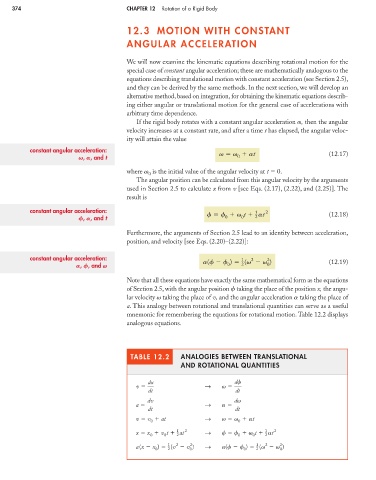
                                                   mnemonic for remembering the equations for rotational motion. Table 12.2 displays
                                                   analogous equations.


                                                    TABLE 12.2     ANALOGIES BETWEEN TRANSLATIONAL
                                                                   AND ROTATIONAL QUANTITIES


                                                         dx                         df
                                                      v                    S
                                                         dt                         dt
                                                         dv                        d
                                                      a                    S
                                                         dt                         dt
                                                      v   v 	 at           S          	  t
                                                          0                          0
                                                                                             1
                                                                  1
                                                      x   x 	 v t 	 at  2  S    f   f 	   t 	  t  2
                                                          0   0   2                  0   0   2
                                                                                                 2
                                                                                          1
                                                                                             2
                                                                  2
                                                               1
                                                                      2
                                                      a(x   x )   (v   v )  S    (f   f )   (      )
                                                           0   2      0               0   2      0

