


Page 215 - Fisika Terapan for Engineers and Scientists
P. 215
13.4  Torque and Angular Momentum as Vectors                      415


                        Hence                                                               (a)
                                                                                                z     When you rotate
                                                 dL      d	                                           gyroscope’s axis, angular
                                                         L                        (13.49)             momentum changes by d L.
                                                  dt      dt
                        According to Eq. (13.49), the magnitude of the torque is
                                                                                                      L   d L
                                                    dL     d	                                          db      d L
                                                t        L                                    O
                                                    dt     dt                                               L         y
                                         2
                        With L   3.0   10  J s and d	 dt   (90 )	(1.0 s)     2 radians/s,
                                                                                            x
                                                   p                    2
                                            2
                                t   3.0   10  J s     radians/s   4.7   10  N m
                                                   2                                        (b)
                                                                                                  z
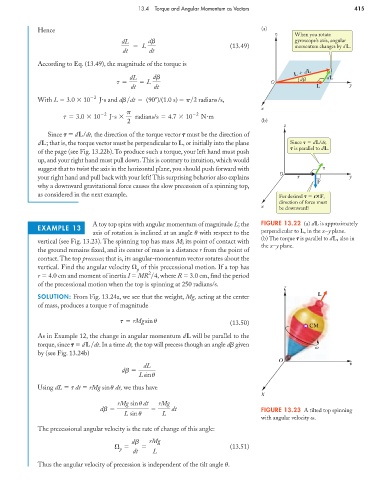
                           Since     dL/dt, the direction of the torque vector   must be the direction of
                        dL; that is, the torque vector must be perpendicular to L, or initially into the plane  Since     d L/dt,
                                                                                                      is parallel to d L.
                        of the page (see Fig. 13.22b).To produce such a torque, your left hand must push
                        up, and your right hand must pull down.This is contrary to intuition, which would
                        suggest that to twist the axis in the horizontal plane, you should push forward with
                                                                                                 O
                        your right hand and pull back with your left! This surprising behavior also explains  r       y
                                                                                                             F
                        why a downward gravitational force causes the slow precession of a spinning top,
                        as considered in the next example.                                       For desired     r F,
                                                                                                 direction of force must
                                                                                            x    be downward!

                                        A toy top spins with angular momentum of magnitude L; the  FIGURE 13.22 (a) dL is approximately
                        EXAMPLE 13
                                        axis of rotation is inclined at an angle   with respect to the  perpendicular to L, in the x–y plane.
                                                                                            (b) The torque   is parallel to dL, also in
                        vertical (see Fig. 13.23). The spinning top has mass M; its point of contact with
                                                                                            the x–y plane.
                        the ground remains fixed, and its center of mass is a distance r from the point of
                        contact.The top precesses; that is, its angular-momentum vector rotates about the
                        vertical. Find the angular velocity   of this precessional motion. If a top has
                                                      p
                                                         2
                        r   4.0 cm and moment of inertia I   MR  4, where R   3.0 cm, find the period
                        of the precessional motion when the top is spinning at 250 radians/s.

                        SOLUTION: From Fig. 13.24a, we see that the weight, Mg, acting at the center         L
                        of mass, produces a torque   of magnitude

                                                 t   rMg sin  u                   (13.50)
                                                                                                          CM
                        As in Example 12, the change in angular momentum dL will be parallel to the
                        torque, since     dL dt. In a time dt, the top will precess though an angle d	 given
                        by (see Fig. 13.24b)

                                                        dL
                                                 d
                                                       Lsinu
                        Using dL     dt   rMg sin  dt, we thus have

                                                rMg sin u dt  rMg
                                           d	                   dt                          FIGURE 13.23 A tilted top spinning
                                                  L sin u     L
                                                                                            with angular velocity  .
                        The precessional angular velocity is the rate of change of this angle:
                                                    d	    rMg
                                                                                  (13.51)
                                                 p
                                                     dt    L
                        Thus the angular velocity of precession is independent of the tilt angle  .

