


Page 216 - Fisika Terapan for Engineers and Scientists
P. 216
416                                CHAPTER 13  Dynamics of a Rigid Body


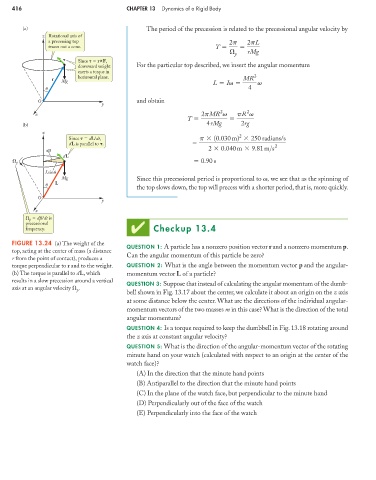
                   (a)                                   The period of the precession is related to the precessional angular velocity by
                         z Rotational axis of
                           a precessing top                                       2p   2pL
                           traces out a cone.                                 T
                                                                                       rMg
                                                                                    p
                                    Since     r F,
                                    downward weight   For the particular top described, we insert the angular momentum
                                    exerts a torque in
                            r       horizontal plane.                                 MR 2
                               Mg                                            L   I
                          u                                                             4
                        O                             and obtain
                                           y
                                                                                       2
                                                                               2
                       x                                                 2pMR       pR
                                                                       T
                   (b)                                                     4rMg      2rg
                         z
                                                                                     2
                                 Since     dL/dt,                        p   (0.030m)   250 radians/s
                                 d L is parallel to  .                                          2
                          db                                                2   0.040m   9.81 m>s
                               d L
                                                                         0.90 s
                  p
                          Lsinu
                               Mg                     Since this precessional period is proportional to  , we see that as the spinning of
                          u  L
                                                      the top slows down, the top will precess with a shorter period, that is, more quickly.
                        O
                                           y
                       x
                      p    db/dt is
                    precessional
                    frequency.                      ✔      Checkup 13.4

                FIGURE 13.24 (a) The weight of the
                                                   QUESTION 1: A particle has a nonzero position vector r and a nonzero momentum p.
                top, acting at the center of mass (a distance
                                                   Can the angular momentum of this particle be zero?
                r from the point of contact), produces a
                torque perpendicular to r and to the weight.  QUESTION 2: What is the angle between the momentum vector p and the angular-
                (b) The torque is parallel to dL, which  momentum vector L of a particle?
                results in a slow precession around a vertical
                                                   QUESTION 3: Suppose that instead of calculating the angular momentum of the dumb-
                axis at an angular velocity   .
                                    p
                                                   bell shown in Fig. 13.17 about the center, we calculate it about an origin on the z axis
                                                   at some distance below the center. What are the directions of the individual angular-
                                                   momentum vectors of the two masses m in this case? What is the direction of the total
                                                   angular momentum?
                                                   QUESTION 4: Is a torque required to keep the dumbbell in Fig. 13.18 rotating around
                                                   the z axis at constant angular velocity?
                                                   QUESTION 5: What is the direction of the angular-momentum vector of the rotating
                                                   minute hand on your watch (calculated with respect to an origin at the center of the
                                                   watch face)?
                                                      (A) In the direction that the minute hand points
                                                      (B) Antiparallel to the direction that the minute hand points
                                                      (C) In the plane of the watch face, but perpendicular to the minute hand
                                                      (D) Perpendicularly out of the face of the watch
                                                      (E) Perpendicularly into the face of the watch

