


Page 244 - Fisika Terapan for Engineers and Scientists
P. 244
444                                CHAPTER 14  Statics and Elasticity


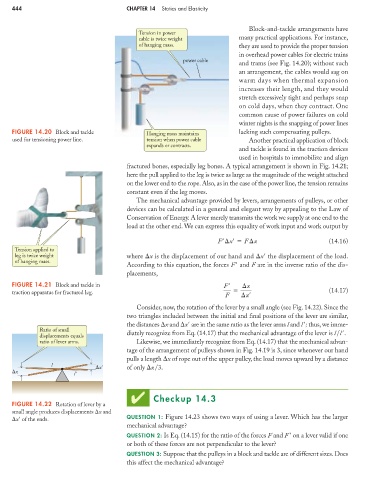
                                                                                        Block-and-tackle arrangements have
                                                      Tension in power
                                                      cable is twice weight          many practical applications. For instance,
                                                      of hanging mass.               they are used to provide the proper tension
                                                                                     in overhead power cables for electric trains
                                                                    power cable
                                                                                     and trams (see Fig. 14.20); without such
                                                                                     an arrangement, the cables would sag on
                                                                                     warm days when thermal expansion
                                                                                     increases their length, and they would
                                                                                     stretch excessively tight and perhaps snap
                                                                                     on cold days, when they contract. One
                                                                                     common cause of power failures on cold
                                                                                     winter nights is the snapping of power lines
                FIGURE 14.20 Block and tackle            Hanging mass maintains      lacking such compensating pulleys.
                used for tensioning power line.          tension when power cable       Another practical application of block
                                                         expands or contracts.
                                                                                     and tackle is found in the traction devices
                                                                                     used in hospitals to immobilize and align
                                                   fractured bones, especially leg bones. A typical arrangement is shown in Fig. 14.21;
                                                   here the pull applied to the leg is twice as large as the magnitude of the weight attached
                                                   on the lower end to the rope. Also, as in the case of the power line, the tension remains
                                                   constant even if the leg moves.
                                                      The mechanical advantage provided by levers, arrangements of pulleys, or other
                                                   devices can be calculated in a general and elegant way by appealing to the Law of
                                                   Conservation of Energy. A lever merely transmits the work we supply at one end to the
                                                   load at the other end. We can express this equality of work input and work output by

                                                                              F  ¢x   F ¢x                      (14.16)
                 Tension applied to
                 leg is twice weight               where 	x is the displacement of our hand and 	x  the displacement of the load.
                 of hanging mass.
                                                   According to this equation, the forces F  and F are in the inverse ratio of the dis-
                                                   placements,
                FIGURE 14.21 Block and tackle in                                F     ¢x
                traction apparatus for fractured leg.                                                           (14.17)
                                                                                 F    ¢x
                                                      Consider, now, the rotation of the lever by a small angle (see Fig. 14.22). Since the
                                                   two triangles included between the initial and final positions of the lever are similar,
                                                   the distances 	x and 	x  are in the same ratio as the lever arms l and l ; thus, we imme-
                        Ratio of small
                        displacements equals       diately recognize from Eq. (14.17) that the mechanical advantage of the lever is l l .
                        ratio of lever arms.          Likewise, we immediately recognize from Eq. (14.17) that the mechanical advan-
                                                   tage of the arrangement of pulleys shown in Fig. 14.19 is 3, since whenever our hand
                                                   pulls a length 	x of rope out of the upper pulley, the load moves upward by a distance
                            l
                                         	x'       of only 	x 3.
                	x
                                   l'
                                                    ✔      Checkup 14.3

                FIGURE 14.22 Rotation of lever by a
                small angle produces displacements 	x and
                                                   QUESTION 1: Figure 14.23 shows two ways of using a lever. Which has the larger
                	x  of the ends.
                                                   mechanical advantage?
                                                   QUESTION 2: Is Eq. (14.15) for the ratio of the forces F and F  on a lever valid if one
                                                   or both of these forces are not perpendicular to the lever?
                                                   QUESTION 3: Suppose that the pulleys in a block and tackle are of different sizes. Does
                                                   this affect the mechanical advantage?

