


Page 245 - Fisika Terapan for Engineers and Scientists
P. 245
14.4  Elasticity of Materials                      445


                                 (a)


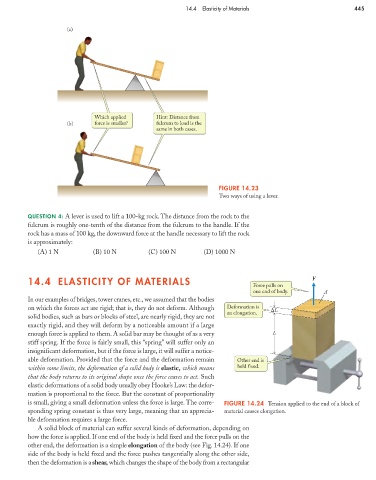
                                         Which applied      Hint: Distance from
                                 (b)     force is smaller?  fulcrum to load is the
                                                            same in both cases.


                                                                               FIGURE 14.23
                                                                               Two ways of using a lever.


                     QUESTION 4: A lever is used to lift a 100-kg rock. The distance from the rock to the
                     fulcrum is roughly one-tenth of the distance from the fulcrum to the handle. If the
                     rock has a mass of 100 kg, the downward force at the handle necessary to lift the rock
                     is approximately:
                        (A) 1 N          (B) 10 N        (C) 100 N        (D) 1000 N


                     14.4 ELASTICITY OF MATERIALS                                                          F
                                                                                         Force pulls on
                                                                                         one end of body.      A
                     In our examples of bridges, tower cranes, etc., we assumed that the bodies
                     on which the forces act are rigid; that is, they do not deform. Although  Deformation is  	L
                                                                                 an elongation.
                     solid bodies, such as bars or blocks of steel, are nearly rigid, they are not
                     exactly rigid, and they will deform by a noticeable amount if a large
                     enough force is applied to them. A solid bar may be thought of as a very  L
                     stiff spring. If the force is fairly small, this “spring” will suffer only an
                     insignificant deformation, but if the force is large, it will suffer a notice-
                     able deformation. Provided that the force and the deformation remain  Other end is
                     within some limits, the deformation of a solid body is elastic, which means  held fixed.
                     that the body returns to its original shape once the force ceases to act. Such
                     elastic deformations of a solid body usually obey Hooke’s Law: the defor-
                     mation is proportional to the force. But the constant of proportionality
                     is small, giving a small deformation unless the force is large. The corre-  FIGURE 14.24 Tension applied to the end of a block of
                     sponding spring constant is thus very large, meaning that an apprecia-  material causes elongation.
                     ble deformation requires a large force.
                        A solid block of material can suffer several kinds of deformation, depending on
                     how the force is applied. If one end of the body is held fixed and the force pulls on the
                     other end, the deformation is a simple elongation of the body (see Fig. 14.24). If one
                     side of the body is held fixed and the force pushes tangentially along the other side,
                     then the deformation is ashear, which changes the shape of the body from a rectangular

