


Page 246 - Fisika Terapan for Engineers and Scientists
P. 246
446                                CHAPTER 14  Statics and Elasticity


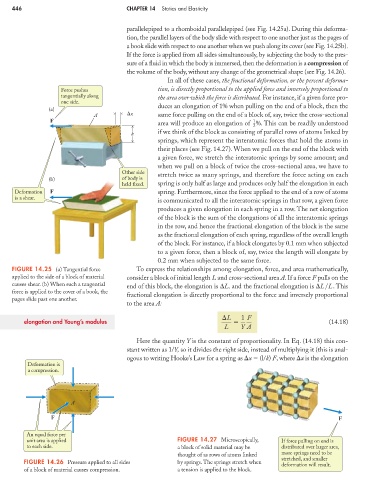
                                                   parallelepiped to a rhomboidal parallelepiped (see Fig. 14.25a). During this deforma-
                                                   tion, the parallel layers of the body slide with respect to one another just as the pages of
                                                   a book slide with respect to one another when we push along its cover (see Fig. 14.25b).
                                                   If the force is applied from all sides simultaneously, by subjecting the body to the pres-
                                                   sure of a fluid in which the body is immersed, then the deformation is a compression of
                                                   the volume of the body, without any change of the geometrical shape (see Fig. 14.26).
                                                               In all of these cases, the fractional deformation, or the percent deforma-
                               Force pushes                 tion, is directly proportional to the applied force and inversely proportional to
                               tangentially along           the area over which the force is distributed. For instance, if a given force pro-
                               one side.
                                                            duces an elongation of 1% when pulling on the end of a block, then the
                           (a)
                                         A         	x       same force pulling on the end of a block of, say, twice the cross-sectional
                            F                                                            1
                                                            area will produce an elongation of %. This can be readily understood
                                                                                         2
                                                    h       if we think of the block as consisting of parallel rows of atoms linked by
                                                            springs, which represent the interatomic forces that hold the atoms in
                                                            their places (see Fig. 14.27). When we pull on the end of the block with
                                                            a given force, we stretch the interatomic springs by some amount; and
                                                            when we pull on a block of twice the cross-sectional area, we have to
                                                 Other side   stretch twice as many springs, and therefore the force acting on each
                           (b)                   of body is
                                                 held fixed.  spring is only half as large and produces only half the elongation in each
                 Deformation  F                             spring. Furthermore, since the force applied to the end of a row of atoms
                 is a shear.
                                                            is communicated to all the interatomic springs in that row, a given force
                                                            produces a given elongation in each spring in a row. The net elongation
                                                            of the block is the sum of the elongations of all the interatomic springs
                                                            in the row, and hence the fractional elongation of the block is the same
                                                            as the fractional elongation of each spring, regardless of the overall length
                                                            of the block. For instance, if a block elongates by 0.1 mm when subjected
                                                            to a given force, then a block of, say, twice the length will elongate by
                                                            0.2 mm when subjected to the same force.
                FIGURE 14.25 (a) Tangential force     To express the relationships among elongation, force, and area mathematically,
                applied to the side of a block of material  consider a block of initial length L and cross-sectional area A. If a force F pulls on the
                causes shear. (b) When such a tangential  end of this block, the elongation is 	L, and the fractional elongation is 	L L. This
                force is applied to the cover of a book, the
                                                   fractional elongation is directly proportional to the force and inversely proportional
                pages slide past one another.
                                                   to the area A:
                                                                                ¢L    1 F
                    elongation and Young’s modulus                                                              (14.18)
                                                                                L     Y A

                                                      Here the quantity Y is the constant of proportionality. In Eq. (14.18) this con-
                                                   stant written as 1/Y, so it divides the right side, instead of multiplying it (this is anal-
                                                   ogous to writing Hooke’s Law for a spring as 	x   (l/k) F, where 	x is the elongation
                     Deformation is
                     a compression.


                                  A

                            F                                                                                      F

                    An equal force per
                    unit area is applied                          FIGURE 14.27 Microscopically,   If force pulling on end is
                    to each side.                                 a block of solid material may be  distributed over larger area,
                                                                  thought of as rows of atoms linked  more springs need to be
                                                                                                  stretched, and smaller
                    FIGURE 14.26 Pressure applied to all sides    by springs. The springs stretch when  deformation will result.
                    of a block of material causes compression.    a tension is applied to the block.

