


Page 38 - Fisika Terapan for Engineers and Scientists
P. 38
238                                CHAPTER 8  Conservation of Energy


                  PROBLEM-SOLVING TECHNIQUES                     ENERGY CONSERVATION


                  To obtain an expression for the total mechanical energy, you
                                                                      CONTRIBUTIONS TO THE MECHANICAL ENERGY
                  must include terms for the different kinds of energy that are
                  present:
                                                                      KIND OF                     CONTRIBUTION TO TOTAL
                                                                      ENERGY       APPLICABLE IF  MECHANICAL ENERGY
                  1 Begin with an expression for the energy at one point
                     [Eq. (8.8)].                                     Kinetic energy  Particle is in   K   mv  2
                                                                                                          1
                                                                                                          2
                                                                                     motion
                  2 And an expression for the energy at another point
                     [Eq. (8.9)].                                     Gravitational  Particle is moving
                                                                       potential     up or down near   U   mgy
                  3 Then use energy conservation to equate these expres-  energy     the Earth’s surface
                     sions [Eq. (8.10)].
                                                                                                          1
                                                                      Elastic      Particle is         U   kx 2
                                                                                                          2
                                                                       potential     subject to a
                     With the appropriate expression for the mechanical
                                                                       energy        spring force
                  energy, you can apply energy conservation to solve some prob-
                  lems of motion. As illustrated in the preceding example, this
                  involves the three steps outlined in Section 7.4 and 8.1.


                                                      To formulate the law of conservation of mechanical energy for a particle moving
                                                   under the influence of some other force, we want to imitate the above construction. We
                                                   will be able to do this if, and only if, the work performed by this force can be expressed
                                                   as a difference between two potential energies, that is,

                                                                              W   U   U                          (8.12)
                                                                                     2    1
                                                   If the force meets this requirement (and therefore permits the construction of a con-
                                                   servation law), the force is called conservative. Thus, the force of gravity and the force
                                                   of a spring are conservative forces. Note that for any such force, the work done when
                                                   the particle starts at the point x and returns to the same point is necessarily zero, since,
                                                                           1
                                                   with x   x , Eq. (8.12) implies
                                                        2   1
                                                                            W   U   U   0                        (8.13)
                                                                                   1    1
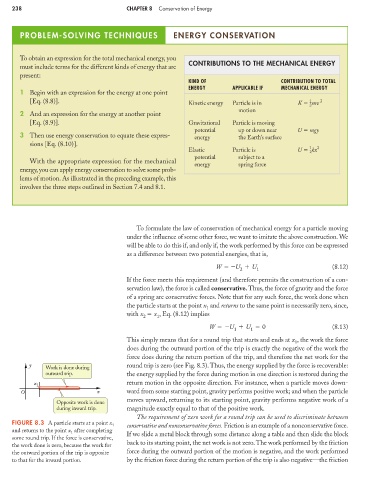
                                                   This simply means that for a round trip that starts and ends at x , the work the force
                                                                                                      1
                                                   does during the outward portion of the trip is exactly the negative of the work the
                                                   force does during the return portion of the trip, and therefore the net work for the
                     y                             round trip is zero (see Fig. 8.3).Thus, the energy supplied by the force is recoverable:
                          Work is done during
                          outward trip.            the energy supplied by the force during motion in one direction is restored during the
                       x 1                         return motion in the opposite direction. For instance, when a particle moves down-
                   O                      x        ward from some starting point, gravity performs positive work; and when the particle
                                                   moves upward, returning to its starting point, gravity performs negative work of a
                              Opposite work is done
                              during inward trip.  magnitude exactly equal to that of the positive work.
                                                      The requirement of zero work for a round trip can be used to discriminate between
                FIGURE 8.3 A particle starts at a point x
                                              1    conservative and nonconservative forces. Friction is an example of a nonconservative force.
                and returns to the point x after completing
                                  1                If we slide a metal block through some distance along a table and then slide the block
                some round trip. If the force is conservative,
                                                   back to its starting point, the net work is not zero.The work performed by the friction
                the work done is zero, because the work for
                the outward portion of the trip is opposite  force during the outward portion of the motion is negative, and the work performed
                to that for the inward portion.    by the friction force during the return portion of the trip is also negative—the friction

