


Page 42 - Fisika Terapan for Engineers and Scientists
P. 42
242                                CHAPTER 8  Conservation of Energy


                  PHYSICS IN PRACTICE              HYDROELECTRIC PUMPED STORAGE


                            The demand for electric energy by industrial and  itational potential energy of the water.This gravitational poten-
                   Concepts
                     in     commercial users is high during working hours,  tial energy can then be held in storage until needed.
                    Context
                            but low during nights and on weekends.For max-  The chapter photo shows the reservoirs of a large hydro-
                            imum efficiency, electric power companies prefer  electric pumped-storage plant on Brown Mountain in New
                  to run their large nuclear or coal-fired power plants at a steady,  York State.The upper reservoir on top of the mountain is linked
                  full output for 24 hours a day, 7 days a week. Thus electric  to the lower reservoir at the base by a vertical shaft of more
                  power companies often have a surplus of electric energy avail-  than 320 m bored through the mountain. Each of the four
                  able at night and on weekends, and they often have a deficit  reversible pump/turbines (see Fig.8.17) and motor/generators
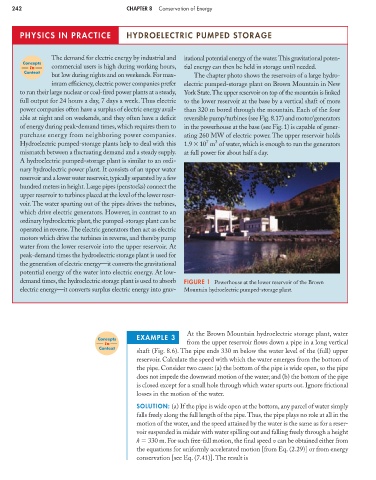
                  of energy during peak-demand times, which requires them to  in the powerhouse at the base (see Fig. 1) is capable of gener-
                  purchase energy from neighboring power companies.  ating 260 MW of electric power. The upper reservoir holds
                                                                           7
                                                                              3
                  Hydroelectric pumped-storage plants help to deal with this  1.9   10 m of water, which is enough to run the generators
                  mismatch between a fluctuating demand and a steady supply.  at full power for about half a day.
                  A hydroelectric pumped-storage plant is similar to an ordi-
                  nary hydroelectric power plant. It consists of an upper water
                  reservoir and a lower water reservoir,typically separated by a few
                  hundred meters in height.Large pipes (penstocks) connect the
                  upper reservoir to turbines placed at the level of the lower reser-
                  voir. The water spurting out of the pipes drives the turbines,
                  which drive electric generators. However, in contrast to an
                  ordinary hydroelectric plant, the pumped-storage plant can be
                  operated in reverse.The electric generators then act as electric
                  motors which drive the turbines in reverse, and thereby pump
                  water from the lower reservoir into the upper reservoir. At
                  peak-demand times the hydroelectric storage plant is used for
                  the generation of electric energy—it converts the gravitational
                  potential energy of the water into electric energy. At low-
                  demand times,the hydroelectric storage plant is used to absorb  FIGURE 1 Powerhouse at the lower reservoir of the Brown
                  electric energy—it converts surplus electric energy into grav-  Mountain hydroelectric pumped-storage plant.


                                                                     At the Brown Mountain hydroelectric storage plant, water
                                          Concepts    EXAMPLE 3
                                            in                       from the upper reservoir flows down a pipe in a long vertical
                                          Context
                                                      shaft (Fig. 8.6). The pipe ends 330 m below the water level of the (full) upper
                                                      reservoir. Calculate the speed with which the water emerges from the bottom of
                                                      the pipe. Consider two cases: (a) the bottom of the pipe is wide open, so the pipe
                                                      does not impede the downward motion of the water; and (b) the bottom of the pipe
                                                      is closed except for a small hole through which water spurts out. Ignore frictional
                                                      losses in the motion of the water.
                                                      SOLUTION: (a) If the pipe is wide open at the bottom, any parcel of water simply
                                                      falls freely along the full length of the pipe.Thus, the pipe plays no role at all in the
                                                      motion of the water, and the speed attained by the water is the same as for a reser-
                                                      voir suspended in midair with water spilling out and falling freely through a height
                                                      h   330 m. For such free-fall motion, the final speed v can be obtained either from
                                                      the equations for uniformly accelerated motion [from Eq. (2.29)] or from energy
                                                      conservation [see Eq. (7.41)]. The result is

