


Page 43 - Fisika Terapan for Engineers and Scientists
P. 43
8.1  Potential Energy of a Conservative Force                  243


                                                    2
                           v   3 2gh    3 2   9.81 m/s   330 m   80 m/s
                           (b) For a closed pipe with a small hole, the motion of a parcel  reservoir
                        of water from the top of the upper reservoir to the hole at the bottom
                        of the pipe is complicated and unknown. However, we can find the
                                                                                             intake
                        final speed of the water by relying on the law of energy conservation
                        as applied to the system consisting of the entire volume of water
                        in the reservoir and the pipe. For this purpose, we must examine the
                        kinetic and the potential energy of the water.The water spurting out                    discharge
                        at the bottom has a large kinetic energy but a low potential energy.
                        In contrast, the water at the top of the upper reservoir has a high
                        potential energy, but next to no kinetic energy (while the water  power plant chamber
                        spurts out at the bottom, the water level in the reservoir gradually
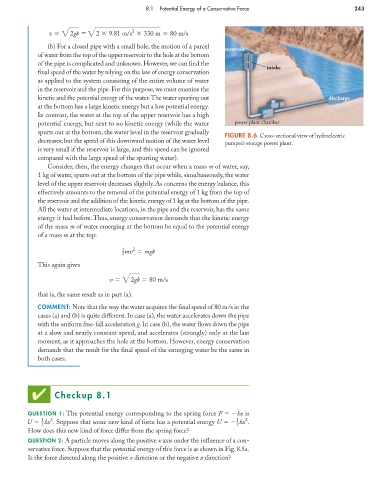
                                                                                 FIGURE 8.6 Cross-sectional view of hydroelectric
                        decreases; but the speed of this downward motion of the water level  pumped-storage power plant.
                        is very small if the reservoir is large, and this speed can be ignored
                        compared with the large speed of the spurting water).
                           Consider, then, the energy changes that occur when a mass m of water, say,
                        1 kg of water, spurts out at the bottom of the pipe while, simultaneously, the water
                        level of the upper reservoir decreases slightly. As concerns the energy balance, this
                        effectively amounts to the removal of the potential energy of 1 kg from the top of
                        the reservoir and the addition of the kinetic energy of 1 kg at the bottom of the pipe.
                        All the water at intermediate locations, in the pipe and the reservoir, has the same
                        energy it had before. Thus, energy conservation demands that the kinetic energy
                        of the mass m of water emerging at the bottom be equal to the potential energy
                        of a mass m at the top:
                                                 1   2
                                                 2 mv   mgh
                        This again gives

                                              v   3 2gh   80 m/s

                        that is, the same result as in part (a).
                        COMMENT: Note that the way the water acquires the final speed of 80 m/s in the
                        cases (a) and (b) is quite different. In case (a), the water accelerates down the pipe
                        with the uniform free-fall acceleration g. In case (b), the water flows down the pipe
                        at a slow and nearly constant speed, and accelerates (strongly) only at the last
                        moment, as it approaches the hole at the bottom. However, energy conservation
                        demands that the result for the final speed of the emerging water be the same in
                        both cases.


                      ✔      Checkup 8.1


                     QUESTION 1: The potential energy corresponding to the spring force F   kx is
                                                                                    1
                            2
                     U    1 2  kx .  Suppose that some new kind of force has a potential energy U     kx 2 .
                                                                                    2
                     How does this new kind of force differ from the spring force?
                     QUESTION 2: A particle moves along the positive x axis under the influence of a con-
                     servative force. Suppose that the potential energy of this force is as shown in Fig. 8.5a.
                     Is the force directed along the positive x direction or the negative x direction?

