


Page 40 - Fisika Terapan for Engineers and Scientists
P. 40
240                                CHAPTER 8  Conservation of Energy


                                                                     As we will see in later chapters, the inverse-square force plays
                                                      EXAMPLE 2
                                                                     a large role in physics—gravitational forces are inverse square,
                                                      and electric forces are inverse square. If we consider a particle that can move in
                                                      only one dimension along the positive x axis, this force has the form

                                                                                        A
                                                                                F  (x)                           (8.18)
                                                                                 x      2
                                                                                       x
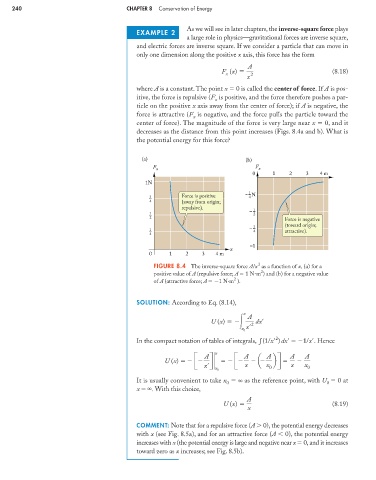
                                                      where A is a constant. The point x   0 is called the center of force. If A is pos-
                                                      itive, the force is repulsive (F is positive, and the force therefore pushes a par-
                                                                              x
                                                      ticle on the positive x axis away from the center of force); if A is negative, the
                                                      force is attractive (F is negative, and the force pulls the particle toward the
                                                                       x
                                                      center of force). The magnitude of the force is very large near x   0, and it
                                                      decreases as the distance from this point increases (Figs. 8.4a and b). What is
                                                      the potential energy for this force?

                                                       (a)                             (b)
                                                           F x                            F x
                                                                                         0     1    2    3   4  m
                                                        1N
                                                                                        1
                                                                                        4
                                                          3        Force is positive   –   N
                                                          4        (away from origin;
                                                                   repulsive).           1
                                                          1                             –  2
                                                          2
                                                                                                   Force is negative
                                                                                                   (toward origin;
                                                                                         3
                                                          1                             –  4       attractive).
                                                          4
                                                                                        –1
                                                                                  x
                                                          0     1    2    3   4 m
                                                                                           2
                                                           FIGURE 8.4 The inverse-square force A/x as a function of x, (a) for a
                                                                                            2
                                                           positive value of A (repulsive force; A   1 N
m ) and (b) for a negative value
                                                                                 .
                                                                                   2
                                                           of A (attractive force; A    1 N m ).
                                                      SOLUTION: According to Eq. (8.14),
                                                                                       x  A
                                                                            U (x)        2   dx
                                                                                      x 0 x
                                                                                                2
                                                      In the compact notation of tables of integrals,  (1/x  ) dx   1/x .  Hence
                                                                              x
                                                                          A           A      A      A    A
                                                              U (x)    B   R  2    B      a    b R
                                                                          x            x     x 0     x   x 0
                                                                              x 0
                                                      It is usually convenient to take x     as the reference point, with U   0 at
                                                                                 0                              0
                                                      x   . With this choice,
                                                                                       A
                                                                                U (x)                            (8.19)
                                                                                       x

                                                      COMMENT: Note that for a repulsive force (A   0), the potential energy decreases
                                                      with x (see Fig. 8.5a), and for an attractive force (A 	 0), the potential energy
                                                      increases with x (the potential energy is large and negative near x  0, and it increases
                                                      toward zero as x increases; see Fig. 8.5b).

