


Page 39 - Fisika Terapan for Engineers and Scientists
P. 39
8.1  Potential Energy of a Conservative Force                  239


                     force always opposes the motion, and the work done by the friction force is always neg-
                     ative. Thus, the work done by the friction force cannot be expressed as a difference
                     between two potential energies, and we cannot formulate a law of conservation of
                     mechanical energy if friction forces are acting. However, as we will see in Section 8.3,
                     we can formulate a more general law of conservation of energy, involving kinds of energy
                     other than mechanical, which remains valid even when there is friction.
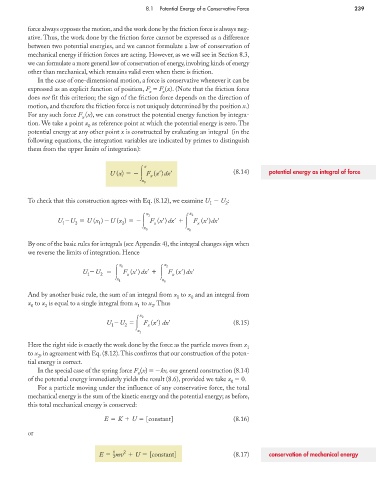
                        In the case of one-dimensional motion, a force is conservative whenever it can be
                     expressed as an explicit function of position, F   F (x). (Note that the friction force
                                                          x   x
                     does not fit this criterion; the sign of the friction force depends on the direction of
                     motion, and therefore the friction force is not uniquely determined by the position x.)
                     For any such force F (x), we can construct the potential energy function by integra-
                                     x
                     tion. We take a point x as reference point at which the potential energy is zero. The
                                       0
                     potential energy at any other point x is constructed by evaluating an integral  (in the
                     following equations, the integration variables are indicated by primes to distinguish
                     them from the upper limits of integration):


                                                         x                         (8.14)     potential energy as integral of force
                                              U (x)      F (x ) dx
                                                          x
                                                       x 0

                     To check that this construction agrees with Eq. (8.12), we examine U   U :
                                                                            1
                                                                                 2
                              U  U   U (x )   U (x )       x 1 F (x ) dx      x 2 F  (x ) dx
                               1   2      1      2         x            x
                                                        x 0          x 0
                     By one of the basic rules for integrals (see Appendix 4), the integral changes sign when
                     we reverse the limits of integration. Hence
                                           2
                                     U  U       x 0 F (x ) dx      x 2 F  (x ) dx
                                       1
                                                   x
                                                                 x
                                                x 1
                                                             x 0
                     And by another basic rule, the sum of an integral from x to x and an integral from
                                                                  1   0
                     x to x is equal to a single integral from x to x . Thus
                      0   2                           1   2
                                                  2
                                             U  U      x 2 F (x ) dx               (8.15)
                                                         x
                                              1
                                                      x 1
                     Here the right side is exactly the work done by the force as the particle moves from x
                                                                                       1
                     to x , in agreement with Eq. (8.12).This confirms that our construction of the poten-
                        2
                     tial energy is correct.
                        In the special case of the spring force F (x)   kx, our general construction (8.14)
                                                      x
                     of the potential energy immediately yields the result (8.6), provided we take x   0.
                                                                                  0
                        For a particle moving under the influence of any conservative force, the total
                     mechanical energy is the sum of the kinetic energy and the potential energy; as before,
                     this total mechanical energy is conserved:
                                            E   K   U   [constant]                 (8.16)

                     or


                                                  2
                                               1
                                          E   mv   U   [constant]                  (8.17)     conservation of mechanical energy
                                               2

