


Page 80 - Fisika Terapan for Engineers and Scientists
P. 80
280                                CHAPTER 9  Gravitation


                                                      SOLUTION: Since the central body is the Earth, the equation analogous to Eq.
                                                      (9.13) is
                   Orbit with period
                   of one day.                                                       4p 2
                                                                                2
                                                                               T          r 3                    (9.15)
                                                                                    GM E
                                                      or
                                                                                         2
                                                                                   GM T
                                                                                       E
                                                                                3
                                                                               r                                 (9.16)
                                                                                     4p 2
                                                      Taking the cube root of both sides of this equation, we find
                                                                   2  1/3
                                 r                           GM T
                                                                E
                                                        r   a    2  b
                                                               4p
                                                                                2
                                                                            2
                                                                                            24
                                                             6.67   10  11  N m /kg   5.98   10 kg   (24   60   60 s) 2  1/3
                                                           a                            2                        b
                                                                                     4p
                      Radius of this geosynchronous
                                                                    7
                      orbit is almost seven times R .      4.23   10 m                                           (9.17)
                                        E
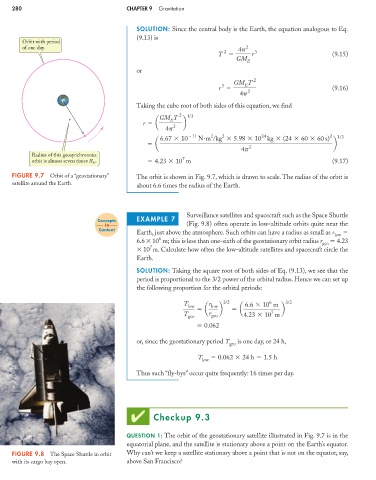
                FIGURE 9.7  Orbit of a “geostationary”  The orbit is shown in Fig. 9.7, which is drawn to scale. The radius of the orbit is
                satellite around the Earth.
                                                      about 6.6 times the radius of the Earth.
                                                                     Surveillance satellites and spacecraft such as the Space Shuttle
                                          Concepts    EXAMPLE 7
                                            in                       (Fig. 9.8) often operate in low-altitude orbits quite near the
                                          Context
                                                      Earth, just above the atmosphere. Such orbits can have a radius as small as r low
                                                             6
                                                      6.6   10 m; this is less than one-sixth of the geostationary orbit radius r geo   4.23
                                                          7
                                                        10 m. Calculate how often the low-altitude satellites and spacecraft circle the
                                                      Earth.
                                                      SOLUTION: Taking the square root of both sides of Eq. (9.13), we see that the
                                                      period is proportional to the 3/2 power of the orbital radius. Hence we can set up
                                                      the following proportion for the orbital periods:
                                                                                              6
                                                                    T       r   3/2    6.6   10 m  3/2
                                                                     low    low
                                                                          a    b     a            b
                                                                                               7
                                                                    T       r         4.23   10 m
                                                                     geo    geo
                                                                          0.062
                                                      or, since the geostationary period T  is one day, or 24 h,
                                                                                  geo
                                                                        T     0.062   24 h   1.5 h
                                                                          low
                                                      Thus such “fly-bys” occur quite frequently: 16 times per day.


                                                    ✔      Checkup 9.3


                                                   QUESTION 1: The orbit of the geostationary satellite illustrated in Fig. 9.7 is in the
                                                   equatorial plane, and the satellite is stationary above a point on the Earth’s equator.
                FIGURE 9.8  The Space Shuttle in orbit  Why can’t we keep a satellite stationary above a point that is not on the equator, say,
                with its cargo bay open.           above San Francisco?

