


Page 86 - Fisika Terapan for Engineers and Scientists
P. 86
286                                CHAPTER 9  Gravitation


                   (a)                                             (b)
                                    100  90  80                                     100  90  80
                                 110            70                               110           70
                              120                  60                        120                   60
                           130                        50                  130                         50
                        140                              40             140                             40
                      150           Earth   DEC            30         150                                  30
                                     JAN
                                  FEB  perihelion
                     160                        NOV          20      160                 Saturn             20
                    170        MAR  Venus                     10    170                  Jupiter             10
                    180                   Mercury  OCT  Mars  0     180                                       0

                    190        APR                 SEP        350   190                                       350
                     200          MAY     aphelion  AUG      340     200                     Uranus          340
                       210             JUN  JUL             330        210                                 330
                                                                                                Neptune
                         220                              320            220   Pluto                     320
                            230                        310                  230                        310
                               240  250  260  270  280  290  300               240  250  260  270  280  290  300

                              11     11     11     11     11                              13                 13
                       0  1   10 m  2   10 m  3   10 m  4   10 m5   10 m  0          0.5   10 m           1    10 m
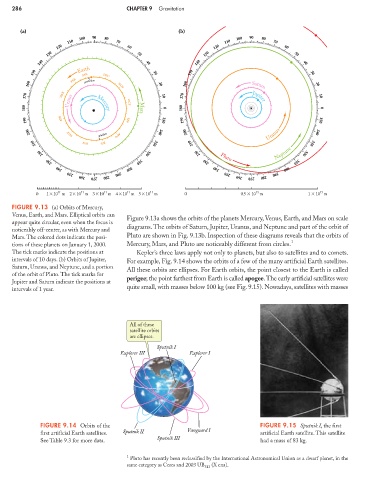
                FIGURE 9.13 (a) Orbits of Mercury,
                Venus, Earth, and Mars. Elliptical orbits can
                                                   Figure 9.13a shows the orbits of the planets Mercury, Venus, Earth, and Mars on scale
                appear quite circular, even when the focus is
                                                   diagrams.The orbits of Saturn, Jupiter, Uranus, and Neptune and part of the orbit of
                noticeably off-center, as with Mercury and
                Mars. The colored dots indicate the posi-  Pluto are shown in Fig. 9.13b. Inspection of these diagrams reveals that the orbits of
                tions of these planets on January 1, 2000.  Mercury, Mars, and Pluto are noticeably different from circles. 1
                The tick marks indicate the positions at  Kepler’s three laws apply not only to planets, but also to satellites and to comets.
                intervals of 10 days. (b) Orbits of Jupiter,  For example, Fig. 9.14 shows the orbits of a few of the many artificial Earth satellites.
                Saturn, Uranus, and Neptune, and a portion
                                                   All these orbits are ellipses. For Earth orbits, the point closest to the Earth is called
                of the orbit of Pluto. The tick marks for
                                                   perigee; the point farthest from Earth is called apogee.The early artificial satellites were
                Jupiter and Saturn indicate the positions at
                                                   quite small, with masses below 100 kg (see Fig. 9.15). Nowadays, satellites with masses
                intervals of 1 year.


                                                    All of these
                                                    satellite orbits
                                                    are ellipses.
                                                            Sputnik I
                                                 Explorer III         Explorer I


                         FIGURE 9.14 Orbits of the                                         FIGURE 9.15 Sputnik I, the first
                         first artificial Earth satellites.  Sputnik II  Vanguard I        artificial Earth satellite. This satellite
                         See Table 9.3 for more data.       Sputnik III                    had a mass of 83 kg.


                                                   1
                                                    Pluto has recently been reclassified by the International Astronomical Union as a dwarf planet, in the
                                                   same category as Ceres and 2003 UB  (X ena).
                                                                          313

