


Page 193 - NAVAL SCIENCE 3 TEXTBOOK
P. 193
MAR!NE NAV!GATION       199

                                                                   Because of GPS, loran coverage is no longer available in much
                        ~,          "",~                        of the world. But in areas it does cover, mostly in and around North

                              ,
                           '" ,  ,  .'                          America, it is a highly reliable system stiJI used by many, including
                                   -.  ............ -1          signals are not receivable. The Department of Homeland Security
                   JUW. _________ .:~                           first  responders  to  emergencies  in  places where the weaker CPS
                                                                has  proposed keeping an  upgraded  enhanced version of the sys-
                                                                tem  (eLoran)  in  operation  in  the  United  States  as  a hack-up to
                                                                GPS, and the British government has proposed the same for areas
                                           N                    around the British Isles.
                                           i                    developed by the  United States is  the Global  Positioning System
                                                                   GPS.  The  newest  electronic  navigation  system  to  have  been

                                                                (CPS).  It consists of a constellation of some twenty-four opera-
                                                                tional  satellites  circling  the  Earth  in  lO,900-mile-high  circular
                                                                orbits, and their supporting ground stations. GPS can provide con-
                                                                tinuous three-dimensional positioning data on land, sea, and air,
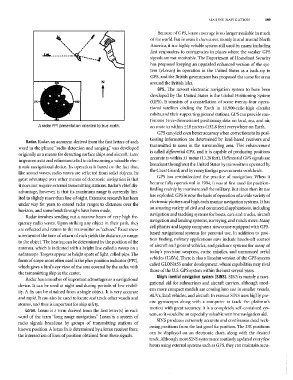
                 A radar PPI  presentation  oriented to true north.   accurate to within ±10 meters (132.8 feet) everywhere on Earth.
                                                                   GPS can yield even better accuracy when corrections to its posi-
                                                                tioning  information  are  determined by land-based  receivers  and
            Radar. Radar, an acronym derived limn the first letters of each
                                                                transmitted  to  users  in  the  surrounding area.  This  enhancement
         word in the phrase "radio detection and ranging," was developed
                                                                is  called differelltinl GPS,  and  it is capable of producing positions
         originally as a means for detecting surface ships and aircraft. Ll;ter
                                                                accurate to within ±1  meter (13.28 feet). Differential GPS signals are
         improvements and refinements led to its becoming a valuable elec-
                                                                broadcast throughout the United States by transmitters operated by
         tronic navigational device.  Its operation is  based on the fact  that,
                                                                the Coast Guard, and by many foreign governments worldwide.
         like sound waves, radio ·waves are reflected from solid objects. Its
                                                                   GPS  has  revolutionized  the  practice  of navigation.  ''''hen it
         great advantage over other means of electronic navigation is that
                                                                became fully operational in 1994, it was at first used for position-
         it does not require external transmitting stations. Radar's chief dis-
                                                                finding mainly by mariners and the military. But since then its use
         advantage, however, is  that its maximulll range  is  currently lim-
                                                                has exploded. (iPS is now the basis of operation of a wide variety of
         ited to slightly more than line-of-sight. Extensive research has been
                                                                electronic plotters and high-tech marine navigation systems. It has
         under way for years  to  e~,'tend radar  ranges to distances over the
                                                                an amazing variety of civil and commercial applications, including
         horizon. and some breakthroughs have been made.
                                                                navigation and tracking systems for boats, cars and trucks, aircraft
            Radar involves sending out a narrow beam of very high fre-
                                                                navigation and landing systems, surveying, and m.uch more. [vIany
         quency radio waves.  Upon striking any object in their path, they
                                                                cell phones and laptop computers now come equipped with GPS-
         are reflected and return to the transmitter as "echoes." Exact mea-
                                                                based navigational systems for personal use.  In addition  to posi-
         surement of the time of return of each yields the distance, or range,
                                                                tion finding, military applications now include hands-off control
         to the object. The bearing can be determined by the position of the
                                                                of aircraft and ground vehicles, and guidance systems for many of
         antenna, which is indicated with a bright line called a sweep on a
                                                                today's precision ·weapons,  cruise missiles,  and  unmanned aerial
         radarscope. Targets appear as bright spots of light, called pips. The
                                                               yehicles (UAVs). There is also a Russian version of the GPS system
         form of scope 1110st often used is the plan position indicator (PPI),
                                                               called GLONASS under development, whose capabilities may rival
         which gives a bird's eye view of the area covered by the radar, with
                                                                those of the U.S. GPS system within the next several years,
         the transmitting ship in the center.
                                                                  Ship's  inertial  navigation system (SINS). SINS is mainly a navi-
            Radar has a number of important advantages as a navigational
                                                               gational aid for  subrnarines and aircraft carriers, although  mod-
         device. It can be used at  night and during periods of low visibil-
                                                               ern more compact models are coming into use in smaller vessels,
         ity. A fix  can be obtained from  a single object. It is very accurate
                                                               AUVs, land vehicles, and aircraft. In essence SINS uses highly pre-
         and rapid. It can also be used to locate and track other vessels and
                                                               cise  gyroscopes  along  with  a  computer  to  track  the  platform's
         storms, and thus is important for ship safety.
                                                                motion with great accuracy. It is a completely self-contained sys-
            Loran.  Loran is  a term derived from the first letter(s)  in each
                                                               tem, so it would be an especially valuable \vartime navigation aid.
         word  of the  term "long range navigation." Loran  is  a system  of
                                                                  SINS produces extremely accurate and continuous dead reck-
         radio  signals  broadcast  by  groups  of  transmitting  stations  of
                                                               oning positions from the last good fix position. The DR positions
         known position. A loran fix is determined by a loran receiver from
                                                               can  be  displayed  on an  electronic chart, along with the  desired
         the intersection of lines of position obtained from these signals.
                                                               track. Although most SINS systems are routinely updated every fe\v
                                                               hours using external systems such as GPS, they can maintain accu-

