


Page 194 - NAVAL SCIENCE 3 TEXTBOOK
P. 194
200      NAVAL SK ILLS

                                                                Dead Reckoning

                                                               \·Vhen a ship is out of sight of lilnd, or electronic navigation is not
                                                               available  and  bad  weather prevents taking celestial  obscrvations,
                                                               thc  ship  must be  navigated  b}'  dead  reckoning.  Dead  reckoning
                                                               means determining a position from the direction and distance the-
                                                               oreticall)· traveled  from  a known stilrting point. normall),  the last
                                                               good fix.
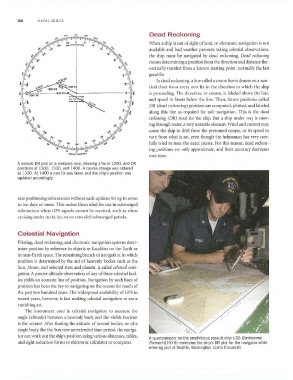
                                                                   In dead reckoning, a line called a collrse Ihle is drawn on a nau-
                                                               tical  chart  from  evcry  new  fix  in  the direction  in  which  the ship
                                                               is proceeding. The dircction, or course,  is labeled  above  the line,
                                                               and speed  in  knots  below  the  line.  Then,  future  positions called
                                                               Dii (dead reckoning) positiolls are computed, plotted, and labeled
                                                               along  this  line  as  required  for  snfc  navigation. This  is  the  dead
                                                               reckon;llg (DR) track  for  the ship. tillt  a ship  under wa),  is  mov-
                                                               ing through water, a vcr)' unstable element. \·Vind and current may
                                                               cause  the ship  to  drift from  the presumed course, or its speed  to
                                                               vary from  what is set, even though the helmsman  has very care-
                                                               fully tried to steer the exact course. For this reason, dead  reckon-
                                                               ing positions are only approximilte, and  their accuraC)'  decreases
                                                               over time.
        A sample DR  plot on a compass rose,  showing a fix at  1200, and  DR
         positions at 1300, 1330, and  1400. A course change was ordered
        at  1330. At  1400 a new fix was  taken and the ship's position  was
         updated accordingly.


         rate positioning information without such updates for up to seven
         to  ten da)'s or more. This makes them ideal for  usc  in submerged
         submarines when  GPS signals cannot be  received, such as  when
         cruising under Arctic ice, or on extended submerged patrols.


         Celestial Navigation

         Piloting, dead reckoning, and electronic navigation systems deter-
         mine position  by reference to  objects or localities on the Earth or
         in near-Earth space. The remaining branch of navigation, in which
         position  is determined by  the aid  of heavenly bodies  stich as the
         Sun, 1\,loon, and selected stars and planets, is called ce/estia/1J(lI'i-
         gatioll. A precise altitude observation of any of these celestial bod-
         ies yields an  accurate line of position. Navigation by such lines of
         position has been the key to navigating on the oceans for much of
         the past two hundred ),ears. The widespread availability of GPS in
         recent  years.  however, is fast  making celestial navigation  at sea  a
         vanishing art.
            The  instrument  lIsed  in  celestial  navigiltion  to  meilsure  the
         angle (altitude)  between a heavenl), bod)' and  the visible horizon
         is the SWnlll. After fi nding the altitude of several bodies, or of a
         single body like the Sun over rill extended time period, the naviga-
         tor can work out the ship's position using various almanacs. tables,
                                                               A quartermaster on  the amphibious assault ship USS  Bonhomme
         and sight reduction forms or electronic calculator or computer.   Richard (LHD 6) maintains the ship's DR  plot for the  navigator while
                                                               entering port at Seattie, Washington. (John Ciccarelli)

