


Page 23 - NAVAL SCIENCE 3 TEXTBOOK
P. 23
28      NAVAl.  KNOWl.EDGE

         modified as conditions require. These principles are:
            A concept of strategic nuclear sufficiency. r.lther than an
            attempt to maintain nuclear superiority
            A strong conventional capability, assisted by increased partici-
            pation and improved defense capabilities of al1ied nations
            Adequate peacetime general purpose forces for meeting a
            major attack against our allies in either Europe or Asia and
            helping with local contingencies sllch as terrorism as required
            Smalier U.S. active forces, with greater emphasis given to their
            readiness and modernization
            Emphasis all a strong research .. md developmcnt program to
            maintain our technological superiority
            Security assistance for the defense needs of friendl}' nations
            ~vlccting the u.S. military needs with an all-\'olunteer active
            force in all services and continued support of the resen'es
            In the years following the terrorist attacks on the United States
         in  September 200 I, President George W.  Bush del'eloped the so-
         called BlisII Doctrille, which held among other things that the threat
         to  the  United  Stotes  posed  by  terrorists  who could  be  equipped
         with modern weapons of mass destruction is so severe thilt  it jus-
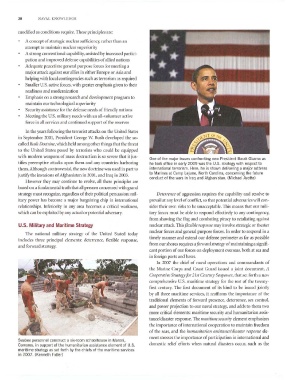
                                                                One of the major issues confronting new Pre,sident Barak Obama as
         tifies preemptive attacks upon them and any countries harboring   he  took office in  early 2009 was  the  U.S.  strategy with respect to
         theIll. Although controversial, the new doctrine was used in part to   international terrorism.  Here,  he  is shown  delivering a major address
                                                                to Marines at Camp  Lejune,  North Carolina,  concerning the future
         justif)' the invasions of Afghanistan in 2001, and Iraq in 2003.
                                                                conduct of the wars in  Iraq and  Afghanistan. (Michael Ayotte)
            However the}'  Illay continue to  evolve,  all  these  principles  are
         based all a fundamental truth that all persons concerned with grand
         stratem' must recognize, regardless of their politic .. ll persuasion: mil-  Deterrence of aggression  requires the capability and resolve  to
         itary  power  has become a  major bargaining chip  in  international   prevail at any level of conflict. so that potential adversaries will con-
         relationships.  Inferiority  in  any '1I"ea  becomes  a critical  weakness,   sider their own risks to be unacceptable. This means that our mili-
         which can be exploited by an)' actual or potential adversary.   tary forces must be able to respond effectively to .my contingenc)l.
                                                                from showing the flag and combating pirac)' to  retaliating against
         U.S. Military and  Maritime Strategy                   nuclear i.ltti.1ck. This flexible respol/Se may involve strategic or theater
                                                                nuclear forces and gel1ef<11  purpose forces. In order to respond in a
            The  national  military  strategy  of  the  United  Stated  today
                                                               timely manner and extend our defense perimeter as far as possible
         includes  three  principal  elements:  deterrence,  flexible  response.
                                                                from our shores requires a forward strategy of maintaining a signifi-
         and forward strategy.
                                                               cant portion of our forces on deploYJllcllt overseas, both at sea and
                                                               in forcign ports and bases.
                                                                   Ln  2007  the  chief of naval  operatiolls and  commandants of
                                                               the  Marine Corps and  Coast Guard  issued  a joint  document, A
                                                               Coopemtil'c Strategy for 21 sl Celltlll)' SrapolI'cr, that sct forth a new
                                                               comprehensive  u.S.  maritime strategy for  the rest of the twenty-
                                                               first  centur),.  The first docllment  of its  kind  to  be  isslled  jointly
                                                               by all  three  maritime services, it  reaffirms the  importallce of the
                                                               traditional elements of forward  presence, deterrence, sea  contro\,
                                                               and power projection to our naval stratcS}', and adds to them two
                                                               more critical elements:  maritime securit), and humanitarian assis-
                                                               tance/disaster response. The /1/aritillle sewrity element emphasizes
                                                               the importance of international cooperat ion to maintain freedom
                                                               of the seas,  and the JllmllHlitnrinll nssistmlcclnisaster respollse ele-
                                                               ment stresses the importance of participation in international and
         Seabee personnel construct a six-room schoolhouse  in Maroni,
         Camoros,  in support of the humanitarian  assistance element of U,S.   domestic  relief eflorts  when  natural disasters  occur, such  as  the
         maritime strategy as  set forth  by the chiefs of the  maritime services
         in  2007. (Ken neth  Fidler)

