


Page 25 - NAVAL SCIENCE 3 TEXTBOOK
P. 25
u.s. Strategy and the Navy


        The mission of the U.S.  Nav)1 is to be prepared to conduct prompt   The Navy's two basic futlctions are sea control .md power pro-
        and sustained combat operations at sea in support of U.S. national   jection. These two  functions are closely related. Sen col/fro/means
         interests.  This basically means  that  maritime superiority for  the   mastery o\'er the entire surface, subsurface, ,md air and near-Earth
         United States mllst be ensured. The U.S. Navy mllst be able to defeat   space above designated sea and  littoral (shore)  areas, or, in other
        an)' potential threats to our continued free  use of the high seas. In   words, over the bnttlespnce within which naval operations are to be
        its simplest terms. defeating:1I1  enemy maritime threat means the   conducted. It also means preventing the approach of enemy forces
         neutralization of hostile spacecmft, aircraft, surface ships, and sub-  within range of our forces or territory, and defense against enemy
         marines that threaten the seaborne forces of the United States and   ballistic and cruise missiles.  It does not imply complete control of
         its allies. The Navy carries out  this mission within the framework   aU  the world's ocean areas, but only where and when  needed. Sea
        of Ollr national strategy in coordination with the other U.S. armed   control is necessary so the Navy may have secure operating areas
        services and in combined planning with our allies.     for  the projectioll of power, sllch as carrier air strikes, amphibious
                                                               assaults, and cruise  missile attacks. The ultimate means of power
                                                               projection is through fleet ballistic missile submarines, a principal
                                                               clement of the nation's strategic ofTensive force.
                                                                  The U.S. Navy is responsible for three functional roles within the
                                                               nationall1lilitary strategy: strategic nuclear deterrence. deployment
                                                               of  ovcrse;]s forces, and security of the sea lines of cOlllmunication.
                                                                  Strategic  nuclear  deterrence.  The effectiveness  of the subma-
                                                               rine-launched ballistic missile, combined  with  the near invulner-
                                                               ability of the ballistic missile submarine, constitutes the strongest
                                                               and  probably most survivable deterrent  in  our strategic nuclear
                                                               forces.  During much of the Cold  \Var, this system was  generally
                                                               regarded as the principal stabilizing factor in  the strategic nuclear
                                                               balance between the Unitcd States and the Soviet Unioll.
                                                                  Overseas-deployed  forces.  The Navy maintains operationally
                                                               read)' naval units overseaS as part of other deployed American and
                                                               allied forces. Well known in this capacity are the Sixth Fleet in  the
                                                               i"lediterranean, the Fifth Pleet in the Indian Ocean. and the Seventh
                                                               fleet ill the western  Pacific. These ships are deployed  where  they
                                                               can  support forward-positioned  U.S.  and  allied  forces  ill peace-
                                                               time and engage enemy forces should hostilities break out.
                                                                  Security  of the  sea  lines  of  communication. The sllccess of the
                                                               forward  military strategy depends upon the Nav),-'s ability to keep
                                                               the sea lines of communication open. both to  sllpport deployed
                                                               U.S.  and  aUied  forces.  and  to  ellsure a continued supply of vital
                                                               imported raw materials for our industry. The protection of friendly
                                                               ships close  to  enemy  shores  where  they  are  most vulnerable  to
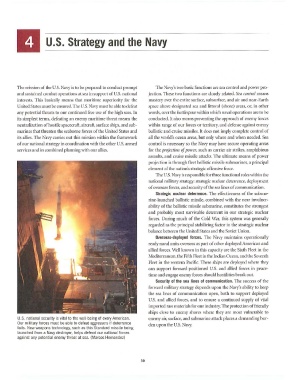
         U.S.  national security is vital to the well-being of every American.   encmy air, surface. and submarine attack places a demanding bur-
         Our military  forces must be able to defeat aggressors if deterrence
                                                               den upon the U.S. Nav)'.
         fails.  New weapons technology, such as this Standard missi le being
         launched from  a Navy destroyer,  helps defend our national forces
         against any potential enemy threat at sea.  (Marcos Hernandez)


                                                            30

