


Page 304 - NS-2 Textbook
P. 304
ASTRONOMY                                                                                             299


                                                                                              number
                                          planetary diameters   distance  from  Sun   orbital period   of
                                                                                              moons
                                                 •
                                          Mercury 3000 miles      4/10           114(88 days)   o
                                                ()
                                           Venus  7526 miles      7110          315(225 days)   o
                                                (J
                                           Earth  7918  miles   1 = 93,000,000 miles   1 =365 days
                                                •
                                           Mars  4200 miles       1-1/2        1-9110(687 days)   2


                                                                   5              12  years    63


                                                                  9-112           29 years     50
                                              G)


                                          Uranus  29,850 miles    19              84 years     27
                                              o

                                         Neptune 31,250 miles      30            165 years     13
                                                 •
                                           Pluto (1430) miles     39             248 years


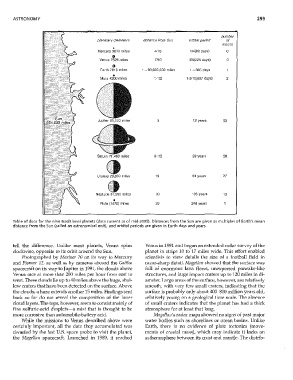
       Table of data for the nine traditional planets (data  current as  of mid-2005). Distances from the Sun  are  given as  multiples of Earth's mean
       distance from  the Sun  (called  an astronomical unit),  and orbital  periods are given in  Earth  days and years.


       tell  the  difference.  Unlike  most  planets,  Venus  spins   Venus in 1991 and began an extended radar survey of the
       clockwise, opposite to its orbit armmd the Sun.        planet in strips 10 to 17 miles wide. This effort enabled
          Photographed by Mariller 10 on its way to Mercury   scientists  to view  details  the  size  of  a  football  field  in
       and Piolleer 12, as well as by cameras aboard the Galileo   razor-sharp detail. Magellall showed that the surface was
       spacecraft on its way to Jupiter in 1991, the clouds above   full  of  enormous  lava  flows,  lmexpected  pancake-like
       Venus race at more than 200 miles per hom from east to   structures, and large impact craters up to 120 miles in di-
       west. These clouds lie up to 40 miles above the huge, shal-  ameter. Large areas of the surface} however, are relatively
       low craters that have been detected on the stu·face. Above   smooth, with very few slnall craters, indicating that the
       the clouds, a haze extends another 15 miles. Findings sent   surface is probably only about 400-800 million years old,
       back so far  do  not reveal  the  composition of the inner   relatively young on a geological time scale. The absence
       cloud layers. The tops, however! seem to consist mainly of   of small craters indicates that the planet has had a thick
       fine  sulfmic-acid droplets-a mist that is thought to be   atmosphere for at least that long.
       more corrosive than automobile-battery acid.              Magellall's radar maps showed no signs of past major
          While the missions  to Venus described  above were   water bodies such as shorelines or ocean basins. Unlike
       certainly important, all the data they accumulated  was   Earth,  there  is  no  evidence  of  plate  tectonics  (move-
       dwarfed by the last u.s. space probe to visit the planet,   ments of crustal  mass), which may indicate it lacks  an
       the  Magellall  spacecraft.  Launched  in  1989,  it  reached   asthenosphere between its crust and mantle. The distrib-

