


Page 109 - Physics Form 5 KSSM_Neat
P. 109
Current can flow from one point to another due to a                                     CHAPTER 3
             potential difference between the two points in a circuit. The      History
             potential difference, V between two points in an electric field is                          Electricity
             the work done, W in moving one coulomb of charge, Q from
             one point to another.


              KEMENTERIAN PENDIDIKAN MALAYSIA
                                  W                 E
                             V =       or   V =
                                  Q                Q
                                                                              Alessandro Volta was an
              where  V = potential difference                                 Italian physicist who invented
                    W = work done                                             the voltaic pile, the first
                     E = energy transferred                                   chemical battery. The unit of
                    Q = the amount of charges flowing                         volt was named in his honour
                                                                              to recognise his contribution in
              The S.I. unit for potential difference, V is joule per coulomb      the field of electricity.
              (J C ) or volt (V).
                 –1
              The potential difference is 1 V if the work done to move 1 C                  Info
              of charge from one point to another is 1 J.
                                                                           Charge of an electron,
                                                                           e = 1.6 × 10  C
                                                                                   –19
                                                                           Therefore,
                                                                           1 C =   1
                                                                               1.6 × 10 –19
                                                                              = 6.25 × 10  electrons
                                                                                     18
             Formative Practice               3.1


                1.  Define current and potential difference.

                2.  What is an electric field?

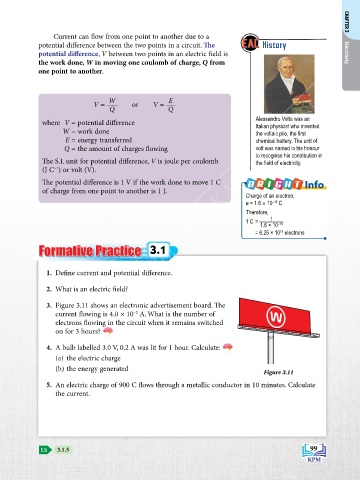
                3.  Figure 3.11 shows an electronic advertisement board. The
                  current flowing is 4.0 × 10  A. What is the number of
                                         –2
                  electrons flowing in the circuit when it remains switched
                  on for 3 hours?

                4.  A bulb labelled 3.0 V, 0.2 A was lit for 1 hour. Calculate:
                  (a)  the electric charge
                  (b) the energy generated
                                                                                Figure 3.11
                5.  An electric charge of 900 C flows through a metallic conductor in 10 minutes. Calculate
                  the current.


             LS     3.1.5                                                                     99

