


Page 113 - Physics Form 5 KSSM_Neat
P. 113
Solving Problems Involving Series and Parallel Combination Circuits                         CHAPTER 3
             Let us recall series circuits and parallel circuits that you have studied in Form 2. The relation
             of current, potential difference and resistance in a series circuit are different from those in a   Electricity
             parallel circuit. Table 3.5 summarises current, potential difference and resistance for series and
             parallel circuits. Based on the summary, you can determine the current, potential difference
             and resistance for series, parallel and combination circuits.
              KEMENTERIAN PENDIDIKAN MALAYSIA
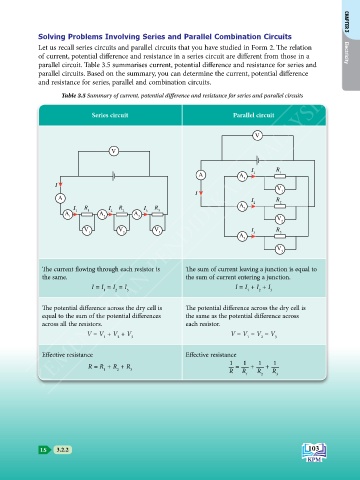
                   Table 3.5 Summary of current, potential difference and resistance for series and parallel circuits


                             Series circuit                            Parallel circuit


                                                                              V

                                  V

                                                                            I       R 1
                                                             A           A   1
                                                                          1
                  I
                                                                                    V
                                                            I                        1
                  A                                                         I       R
                                                                         A   2       2
                       I  R 1     I  R 2    I  R 3                        2
                    A   1      A  2      A   3
                      1         2         3
                                                                                    V
                                                                                     2
                          V          V         V                            I       R
                            1         2          3                           3       3
                                                                         A
                                                                          3
                                                                                    V
                                                                                     3
              The current flowing through each resistor is   The sum of current leaving a junction is equal to
              the same.                                  the sum of current entering a junction.
                             I = I  = I  = I                            I = I  + I  + I
                                1   2  3                                   1   2  3

              The potential difference across the dry cell is   The potential difference across the dry cell is
              equal to the sum of the potential differences   the same as the potential difference across
              across all the resistors.                  each resistor.
                           V = V  + V  + V                            V = V  = V  = V
                                1   2   3                                  1   2    3

              Effective resistance                       Effective resistance
                                                                      1   1    1   1
                           R = R  + R  + R                              =    +    +
                                1   2   3                             R   R   R    R
                                                                           1   2    3


             LS     3.2.2                                                                     103

