


Page 110 - Physics Form 5 KSSM_Neat
P. 110
SCAN ME
           3.2   Resistance                                                      SCAN ME
                                                                                   Ohm’s Law
           Ohmic Conductor and Non-Ohmic Conductor

           A conductor which obeys Ohm’s Law is called an ohmic                 https://bit.ly/31uiGir
           conductor whereas a conductor which does not obey Ohm’s Law
            KEMENTERIAN PENDIDIKAN MALAYSIA
           is called a non-ohmic conductor. Do the potential difference and      SCAN ME
                                                                                 SCAN ME
           the current vary according to Ohm’s Law for conductors such as          Video on
           a constantan wire and a bulb? Carry out Experiment 3.1.                 Ohm’s Law
                                                                                https://bit.ly/2QzBPZP


                 x              t 3.1

             Inference: The potential difference across a conductor depends on the current flowing through it
             Hypothesis: The higher the current, the higher the potential difference across the conductor
             Aim:  To study the relationship between the current and the potential difference of an ohmic
                  conductor and a non-ohmic conductor
             A Ohmic conductor (a constantan wire)
             Variables:
             (a)  Manipulated: Current, I
             (b)  Responding: Potential difference, V                    Info GALLERY
             (c)  Constant: Temperature, diameter and length of constantan wire
                                                                         Standard wire gauge (s.w.g.)
             Apparatus:  1.5 V dry cell, cell holder, switch, connecting wires,   represents the diameter of a wire.
                        ammeter, voltmeter, metre rule, rheostat, constantan   The bigger the value of its s.w.g.,
                        wire s.w.g 24 (20 cm length)                     the smaller the diameter.
             Procedure:
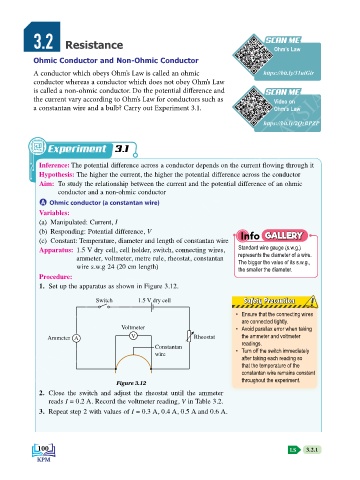
             1.  Set up the apparatus as shown in Figure 3.12.
                                                                          Safety Precaution
                              Switch      1.5 V dry cell                  Safety Precaution
                                                                        •  Ensure that the connecting wires
                                                                          are connected tightly.
                                     Voltmeter                          •  Avoid parallax error when taking
               Ammeter A                V                  Rheostat       the ammeter and voltmeter
                                                                          readings.
                                                Constantan              •  Turn off the switch immediately
                                                wire
                                                                          after taking each reading so
                                                                          that the temperature of the
                                                                          constantan wire remains constant
                                                                          throughout the experiment.
                                    Figure 3.12
             2.  Close  the  switch  and  adjust  the  rheostat  until  the  ammeter
                reads I = 0.2 A. Record the voltmeter reading, V in Table 3.2.
             3.  Repeat step 2 with values of I = 0.3 A, 0.4 A, 0.5 A and 0.6 A.


            100                                                                         LS     3.2.1

