


Page 382 - Critical Care Nursing Demystified
P. 382
Chapter 8  CARE OF THE PATIENT WITH CRITICAL RENAL NEEDS        367


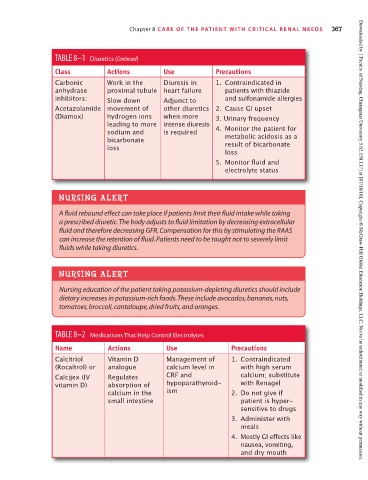
                               TABLE 8–1  Diuretics (Continued)
                               Class          Actions         Use           Precautions
                               Carbonic       Work in the     Diuresis in   1.  Contraindicated in
                               anhydrase      proximal tubule  heart failure   patients with thiazide
                               inhibitors:    Slow down       Adjunct to       and sulfonamide allergies
                               Acetazolamide  movement of     other diuretics  2.  Cause GI upset
                               (Diamox)       hydrogen ions   when more     3. Urinary frequency
                                              leading to more  intense diuresis
                                              sodium and      is required   4.  Monitor the patient for
                                              bicarbonate                      metabolic acidosis as a
                                              loss                             result of bicarbonate
                                                                               loss
                                                                            5.  Monitor fluid and
                                                                                 electrolyte status


                                 NURSING ALERT

                                 A fluid rebound effect can take place if patients limit their fluid intake while taking

                                 a prescribed diuretic. The body adjusts to fluid limitation by decreasing extracellular


                                 fluid and therefore decreasing GFR. Compensation for this by stimulating the RAAS

                                 can increase the retention of fluid. Patients need to be taught not to severely limit   Downloaded by [ Faculty of Nursing, Chiangmai University 5.62.158.117] at [07/18/16]. Copyright © McGraw-Hill Global Education Holdings, LLC. Not to be redistributed or modified in any way without permission.
                                 fluids while taking diuretics.

                                 NURSING ALERT

                                 Nursing education of the patient taking potassium-depleting diuretics should include
                                 dietary increases in potassium-rich foods. These include avocados, bananas, nuts,
                                 tomatoes, broccoli, cantaloupe, dried fruits, and oranges.


                               TABLE 8–2  Medications That Help Control Electrolytes
                               Name           Actions          Use               Precautions
                               Calcitriol     Vitamin D        Management of     1.  Contraindicated
                               (Rocaltrol) or   analogue       calcium level in    with high serum
                               Calcijex (IV   Regulates        CRF and             calcium; substitute
                               vitamin D)     absorption of    hypoparathyroid-    with Renagel
                                              calcium in the   ism               2.  Do not give if
                                              small intestine                      patient is hyper-
                                                                                   sensitive to drugs
                                                                                 3.  Administer with
                                                                                   meals
                                                                                 4.  Mostly GI effects like
                                                                                   nausea, vomiting,
                                                                                   and dry mouth

