


Page 383 - Critical Care Nursing Demystified
P. 383
368        CRITICAL CARE NURSING  DeMYSTIFIED


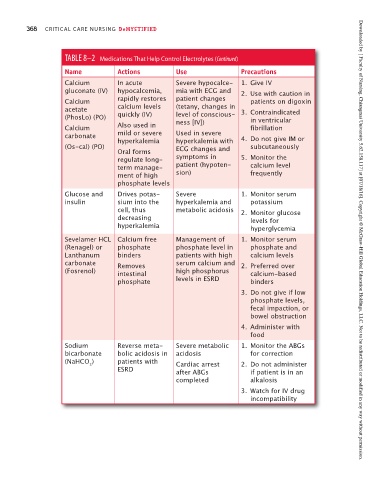
                             TABLE 8–2  Medications That Help Control Electrolytes (Continued)
                             Name           Actions         Use               Precautions
                             Calcium        In acute        Severe hypocalce-  1.  Give IV
                               gluconate (IV)  hypocalcemia,   mia with ECG and   2.  Use with caution in
                             Calcium        rapidly restores   patient changes   patients on digoxin
                               acetate      calcium levels   (tetany, changes in   3.  Contraindicated
                             (PhosLo) (PO)  quickly (IV)    level of conscious-  in ventricular
                                                            ness [IV])
                             Calcium        Also used in                         fibrillation
                               carbonate    mild or severe   Used in severe
                                            hyperkalemia    hyperkalemia with   4.  Do not give IM or
                             (Os-cal) (PO)                  ECG changes and      subcutaneously
                                            Oral forms
                                            regulate long-  symptoms in       5.  Monitor the
                                            term manage-    patient (hypoten-    calcium level
                                            ment of high    sion)                frequently
                                            phosphate levels
                             Glucose and    Drives potas-   Severe            1.  Monitor serum
                             insulin        sium into the   hyperkalemia and     potassium
                                            cell, thus      metabolic acidosis  2.  Monitor glucose
                                            decreasing                           levels for
                                            hyperkalemia                         hyperglycemia

                             Sevelamer HCL  Calcium free    Management of     1.  Monitor serum                 Downloaded by [ Faculty of Nursing, Chiangmai University 5.62.158.117] at [07/18/16]. Copyright © McGraw-Hill Global Education Holdings, LLC. Not to be redistributed or modified in any way without permission.
                             (Renagel) or   phosphate       phosphate level in   phosphate and
                             Lanthanum      binders         patients with high   calcium levels
                             carbonate      Removes         serum calcium and   2.  Preferred over
                             (Fosrenol)     intestinal      high phosphorus      calcium-based
                                            phosphate       levels in ESRD       binders
                                                                              3.  Do not give if low
                                                                                 phosphate levels,
                                                                                 fecal impaction, or
                                                                                 bowel obstruction
                                                                              4.  Administer with
                                                                                 food
                             Sodium         Reverse meta-   Severe metabolic   1.  Monitor the ABGs
                               bicarbonate   bolic acidosis in  acidosis         for correction
                             (NaHCO )       patients with   Cardiac arrest    2.  Do not administer
                                    3
                                            ESRD            after ABGs           if patient is in an
                                                              completed          alkalosis
                                                                              3.  Watch for IV drug
                                                                                 incompatibility

