


Page 113 - Color_Atlas_of_Physiology_5th_Ed._-_A._Despopoulos_2003
P. 113
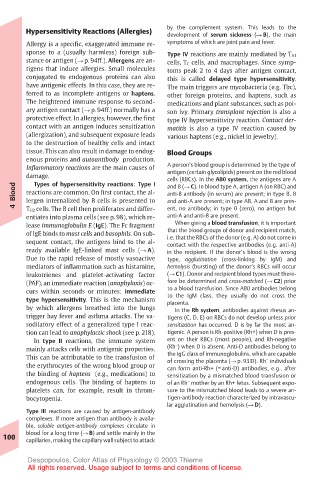
Hypersensitivity Reactions (Allergies)  by the complement system. This leads to the
                                       development of serum sickness (! B), the main
       Allergy is a specific, exaggerated immune re-  symptoms of which are joint pain and fever.
       sponse to a (usually harmless) foreign sub-  Type IV reactions are mainly mediated by T H1
       stance or antigen (! p. 94ff.). Allergens are an-  cells, T C cells, and macrophages. Since symp-
       tigens that induce allergies. Small molecules  toms peak 2 to 4 days after antigen contact,
       conjugated to endogenous proteins can also  this is called delayed type hypersensitivity.
       have antigenic effects. In this case, they are re-  The main triggers are mycobacteria (e.g. Tbc),
       ferred to as incomplete antigens or haptens.  other foreign proteins, and haptens, such as
       The heightened immune response to second-  medications and plant substances, such as poi-
       ary antigen contact (! p. 94ff.) normally has a  son ivy. Primary transplant rejection is also a
       protective effect. In allergies, however, the first  type IV hypersensitivity reaction. Contact der-
       contact with an antigen induces sensitization  matitis is also a type IV reaction caused by
       (allergization), and subsequent exposure leads  various haptens (e.g., nickel in jewelry).
       to the destruction of healthy cells and intact
       tissue. This can also result in damage to endog-  Blood Groups
       enous proteins and autoantibody production.
       Inflammatory reactions are the main causes of  A person’s blood group is determined by the type of
                                       antigen (certain glycolipids) present on the red blood
       damage.                         cells (RBCs). In the AB0 system, the antigens are A
         Types of hypersensitivity reactions: Type I
    Blood  reactions are common. On first contact, the al-  and B (! C). In blood type A, antigen A (on RBC) and
                                       anti-B antibody (in serum) are present; in type B, B
    4  lergen internalized by B cells is presented to  and anti-A are present; in type AB, A and B are pres-
                                       ent, no antibody; in type 0 (zero), no antigen but
       T H2 cells. The B cell then proliferates and differ-
       entiates into plasma cells (see p. 98), which re-  anti-A and anti-B are present.
                                        When giving a blood transfusion, it is important
       lease immunoglobulin E (IgE). The Fc fragment  that the blood groups of donor and recipient match,
       of IgE binds to mast cells and basophils. On sub-  i.e. that the RBCs of the donor (e.g. A) do not come in
       sequent contact, the antigens bind to the al-  contact with the respective antibodies (e.g. anti-A)
       ready available IgE-linked mast cells (! A).  in the recipient. If the donor’s blood is the wrong
       Due to the rapid release of mostly vasoactive  type, agglutination (cross-linking by IgM) and
       mediators of inflammation such as histamine,  hemolysis (bursting) of the donor’s RBCs will occur
       leukotrienes and platelet-activating factor  (! C1). Donor and recipient blood types must there-
       (PAF), an immediate reaction (anaphylaxis) oc-  fore be determined and cross-matched (! C2) prior
       curs within seconds or minutes: immediate  to a blood transfusion. Since AB0 antibodies belong
                                       to the IgM class, they usually do not cross the
       type hypersensitivity. This is the mechanism  placenta.
       by which allergens breathed into the lungs  In the Rh system, antibodies against rhesus an-
       trigger hay fever and asthma attacks. The va-  tigens (C, D, E) on RBCs do not develop unless prior
       sodilatory effect of a generalized type I reac-  sensitization has occurred. D is by far the most an-
       tion can lead to anaphylactic shock (see p. 218).  tigenic. A person is Rh-positive (Rh+) when D is pres-
         In type II reactions, the immune system  ent on their RBCs (most people), and Rh-negative
                                         –
       mainly attacks cells with antigenic properties.  (Rh ) when D is absent. Anti-D antibodies belong to
       This can be attributable to the transfusion of  the IgG class of immunoglobulins, which are capable
                                       of crossing the placenta (! p. 93 D). Rh individuals
                                                             –
       the erythrocytes of the wrong blood group or  can form anti-Rh+ (= anti-D) antibodies, e.g., after
       the binding of haptens (e.g., medications) to  sensitization by a mismatched blood transfusion or
       endogenous cells. The binding of haptens to  of an Rh mother by an Rh+ fetus. Subsequent expo-
                                           –
       platelets can, for example, result in throm-  sure to the mismatched blood leads to a severe an-
       bocytopenia.                    tigen-antibody reaction characterized by intravascu-
                                       lar agglutination and hemolysis (! D).
       Type III reactions are caused by antigen-antibody
       complexes. If more antigen than antibody is availa-
       ble, soluble antigen-antibody complexes circulate in
       blood for a long time (! B) and settle mainly in the
  100  capillaries, making the capillary wall subject to attack
       Despopoulos, Color Atlas of Physiology © 2003 Thieme
       All rights reserved. Usage subject to terms and conditions of license.

