


Page 143 - Color_Atlas_of_Physiology_5th_Ed._-_A._Despopoulos_2003
P. 143
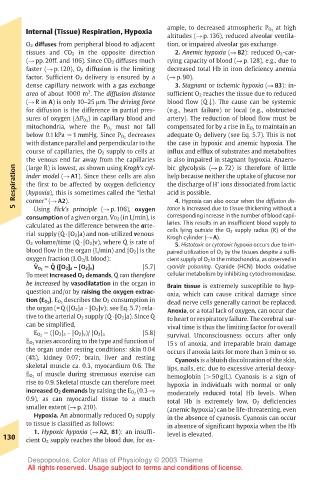
ample, to decreased atmospheric P O 2 at high
       Internal (Tissue) Respiration, Hypoxia
                                       altitudes (! p. 136), reduced alveolar ventila-
       O 2 diffuses from peripheral blood to adjacent  tion, or impaired alveolar gas exchange.
       tissues and CO 2 in the opposite direction  2. Anemic hypoxia (! B2): reduced O 2-car-
       (! pp. 20ff. and 106). Since CO 2 diffuses much  rying capacity of blood (! p. 128), e.g., due to
       faster (! p. 120), O 2 diffusion is the limiting  decreased total Hb in iron deficiency anemia
       factor. Sufficient O 2 delivery is ensured by a  (! p. 90).
       dense capillary network with a gas exchange  3. Stagnant or ischemic hypoxia (! B3): in-
                     2
       area of about 1000 m . The diffusion distance  sufficient O 2 reaches the tissue due to reduced
                                               .
       (! R in A) is only 10–25µm. The driving force  blood flow (Q"). The cause can be systemic
       for diffusion is the difference in partial pres-  (e.g., heart failure) or local (e.g., obstructed
       sures of oxygen (∆P O 2 ) in capillary blood and  artery). The reduction of blood flow must be
       mitochondria, where the P O 2 must not fall  compensated for by a rise in E O 2 to maintain an
       below 0.1 kPa ! 1 mmHg. Since P O 2 decreases  adequate O 2 delivery (see Eq. 5.7). This is not
       with distance parallel and perpendicular to the  the case in hypoxic and anemic hypoxia. The
       course of capillaries, the O 2 supply to cells at  influx and efflux of substrates and metabolites
       the venous end far away from the capillaries  is also impaired in stagnant hypoxia. Anaero-
                                       bic glycolysis (! p. 72) is therefore of little
    Respiration  (hypoxia), this is sometimes called the “lethal  help because neither the uptake of glucose nor
       (large R) is lowest, as shown using Krogh’s cyl-
       inder model (! A1). Since these cells are also
                                       the discharge of H ions dissociated from lactic
                                                  +
       the first to be affected by oxygen deficiency
                                       acid is possible.
                                        4. Hypoxia can also occur when the diffusion dis-
    5  corner” (! A2).                 tance is increased due to tissue thickening without a
         Using Fick’s principle (! p. 106), oxygen
                          .
       consumption of a given organ, VO 2 (in L/min), is  corresponding increase in the number of blood capil-
       calculated as the difference between the arte-  laries. This results in an insufficient blood supply to
               .
                                       cells lying outside the O 2 supply radius (R) of the
       rial supply (Q ! [O 2]a) and non-utilized venous  Krogh cylinder (! A).
                  .
                             .
       O 2 volume/time (Q ! [O 2]v), where Q is rate of  5. Histotoxic or cytotoxic hypoxia occurs due to im-
       blood flow in the organ (L/min) and [O 2] is the  paired utilization of O 2 by the tissues despite a suffi-
       oxygen fraction (L O 2/L blood):  cient supply of O 2 in the mitochondria, as observed in
             .
         .
         V O 2 ! Q ([O 2] a – [O 2] v)  .  [5.7]  cyanide poisoning. Cyanide (HCN) blocks oxidative
       To meet increased O 2 demands, Q can therefore  cellular metabolism by inhibiting cytochromoxidase.
       be increased by vasodilatation in the organ in  Brain tissue is extremely susceptible to hyp-
       question and/or by raising the oxygen extrac-  oxia, which can cause critical damage since
       tion (E O 2 ). E O 2 describes the O 2 consumption in  dead nerve cells generally cannot be replaced.
               .
       the organ (= Q ([O 2]a – [O 2]v); see Eq. 5.7) rela- .  Anoxia, or a total lack of oxygen, can occur due
                         .
       tive to the arterial O 2 supply (Q ! [O 2]a). Since Q  to heart or respiratory failure. The cerebral sur-
       can be simplified,              vival time is thus the limiting factor for overall
         E O 2 ! ([O 2] a – [O 2] v)/ [O 2] a  [5.8]  survival. Unconsciousness occurs after only
       E O 2 varies according to the type and function of  15 s of anoxia, and irreparable brain damage
       the organ under resting conditions: skin 0.04  occurs if anoxia lasts for more than 3 min or so.
       (4%), kidney 0.07; brain, liver and resting  Cyanosis is a bluish discoloration of the skin,
       skeletal muscle ca. 0.3, myocardium 0.6. The  lips, nails, etc. due to excessive arterial deoxy-
       E O 2 of muscle during strenuous exercise can  hemoglobin (" 50 g/L). Cyanosis is a sign of
       rise to 0.9. Skeletal muscle can therefore meet  hypoxia in individuals with normal or only
       increased O 2 demands by raising the E O 2 (0.3 "  moderately reduced total Hb levels. When
       0.9), as can myocardial tissue to a much  total Hb is extremely low, O 2 deficiencies
       smaller extent (! p. 210).      (anemic hypoxia) can be life-threatening, even
         Hypoxia. An abnormally reduced O 2 supply  in the absence of cyanosis. Cyanosis can occur
       to tissue is classified as follows:  in absence of significant hypoxia when the Hb
         1. Hypoxic hypoxia (! A2, B1): an insuffi-
  130  cient O 2 supply reaches the blood due, for ex-  level is elevated.
       Despopoulos, Color Atlas of Physiology © 2003 Thieme
       All rights reserved. Usage subject to terms and conditions of license.

