


Page 155 - Color_Atlas_of_Physiology_5th_Ed._-_A._Despopoulos_2003
P. 155
Acidosis and Alkalosis          Nonrespiratory (Metabolic) Acid–Base
                                       Disturbances
       The main objective of acid–base regulation is  Nonrespiratory acidosis is most commonly
       to keep the pH of blood, and thus of the body,  caused by (1) renal failure or isolated renal
                                             +
       constant. The normal ranges for parameters  tubular H secretion defect resulting in inabil-
                                                                +
       relevant  to  acid–base  homeostasis,  as  ity to eliminate normal quantities of H ions
       measured in plasma (arterialized capillary  (renal acidosis); (2) hyperkalemia (! p. 180);
       blood) are listed in the table (see table on  (3) increased !-hydroxybutyric acid and ace-
                              –
       p. 124 for erythrocyte P CO 2 and [HCO 3 ] values).  toacetic acid production (diabetes mellitus,
                                       starvation); (4) increased anaerobic conver-
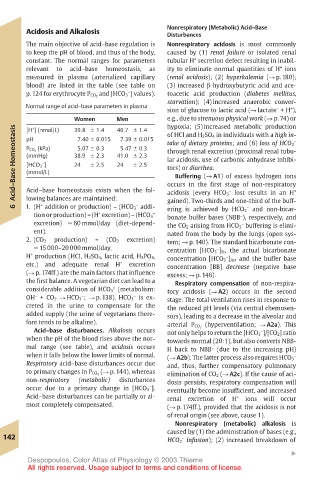
       Normal range of acid–base parameters in plasma
                                                               –
                                       sion of glucose to lactic acid (! lactate + H ),
                                                                  +
                  Women    Men         e.g., due to strenuous physical work (! p. 74) or
                                       hypoxia; (5) increased metabolic production
    Acid–Base Homeostasis  P CO 2 (kPa)  38.9 ! 2.3  41.0 ! 2.3  take of dietary proteins; and (6) loss of HCO 3 –
                  39.8 ! 1.4
        +
       [H ] (nmol/L)
                           40.7 ! 1.4
                                       of HCl and H 2SO 4 in individuals with a high in-
                  7.40 ! 0.015
                            7.39 ! 0.015
       pH
                            5.47 ! 0.3
                  5.07 ! 0.3
                                       through renal excretion (proximal renal tubu-
       (mmHg)
                                       lar acidosis, use of carbonic anhydrase inhibi-
                     ! 2.5
                               ! 2.5
                  24
                           24
       [HCO 3 ]
          –
                                       tors) or diarrhea.
       (mmol/L)
                                        Buffering (! A1) of excess hydrogen ions
                                       occurs in the first stage of non-respiratory
       Acid–base homeostasis exists when the fol-
                                                     –
                                       gained). Two-thirds and one-third of the buff-
          +
       1. (H addition or production) – (HCO 3 addi-
    6  lowing balances are maintained:  –  acidosis (every HCO 3 lost results in an H +
                                       ering is achieved by HCO 3 and non-bicar-
                                                         –
                       +           –
                                                       –
         tion or production) = (H excretion) – (HCO 3  bonate buffer bases (NBB ), respectively, and
         excretion) ! 60 mmol/day (diet-depend-  the CO 2 arising from HCO 3 buffering is elimi-
                                                       –
         ent).                         nated from the body by the lungs (open sys-
       2. (CO 2  production)  =  (CO 2  excretion)  tem; ! p. 140). The standard bicarbonate con-
         ! 15 000–20 000 mmol/day.     centration [HCO 3 ] St, the actual bicarbonate
                                                  –
       H production (HCl, H 2SO 4, lactic acid, H 3PO 4,  concentration [HCO 3 ] Act and the buffer base
        +
                                                    –
       etc.)  and  adequate  renal  H +  excretion  concentration [BB] decrease (negative base
       (! p. 174ff.) are the main factors that influence  excess; ! p. 146).
       the first balance. A vegetarian diet can lead to a  Respiratory compensation of non-respira-
                          –
       considerable addition of HCO 3 (metabolism:  tory acidosis (! A2) occurs in the second
         –
       OH + CO 2 ! HCO 3 ; ! p. 138). HCO 3 is ex-  stage. The total ventilation rises in response to
                   –
                               –
       creted in the urine to compensate for the  the reduced pH levels (via central chemosen-
       added supply (the urine of vegetarians there-  sors), leading to a decrease in the alveolar and
       fore tends to be alkaline).     arterial P CO 2 (hyperventilation; ! A2a). This
         Acid–base disturbances. Alkalosis occurs  not only helps to return the [HCO 3 ]/[CO 2] ratio
                                                            –
       when the pH of the blood rises above the nor-  towards normal (20:1), but also converts NBB-
       mal range (see table), and acidosis occurs  H back to NBB (due to the increasing pH)
                                                 –
       when it falls below the lower limits of normal.  (! A2b). The latter process also requires HCO 3 –
       Respiratory acid–base disturbances occur due  and, thus, further compensatory pulmonary
       to primary changes in P CO 2 (! p. 144), whereas  elimination of CO 2 (! A2c). If the cause of aci-
       non-respiratory  (metabolic)  disturbances  dosis persists, respiratory compensation will
       occur due to a primary change in [HCO 3 ].  eventually become insufficient, and increased
                                   –
       Acid–base disturbances can be partially or al-  renal  excretion  of  H +  ions  will  occur
       most completely compensated.    (! p. 174ff.), provided that the acidosis is not
                                       of renal origin (see above, cause 1).
                                        Nonrespiratory (metabolic) alkalosis is
                                       caused by (1) the administration of bases (e.g.,
  142                                  HCO 3 infusion); (2) increased breakdown of
                                          –
                                                                   !
       Despopoulos, Color Atlas of Physiology © 2003 Thieme
       All rights reserved. Usage subject to terms and conditions of license.

