


Page 395 - Color_Atlas_of_Physiology_5th_Ed._-_A._Despopoulos_2003
P. 395
2
                 ln y
                                     ln y  3

                        y=a·e b·x

                    lny=lna + b·x
                                              y=a·x b
                                              lny=lna + b·lnx


                    Exponential function
    Appendix            x (linear)  Power function


    13  1                                                   ln x
                 y (linear)              4
                                      y (linear)


                          Linear function            y=a + b·lnx

                                      Logarithmic function

                        x (linear)

                                                              ln x
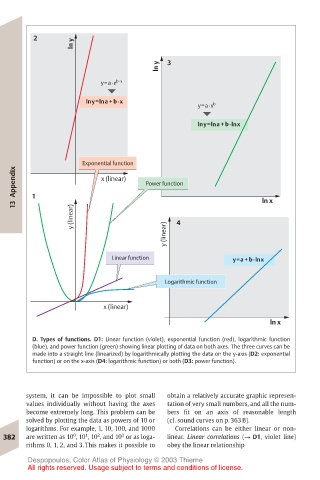
        D. Types of functions. D1: Linear function (violet), exponential function (red), logarithmic function
        (blue), and power function (green) showing linear plotting of data on both axes. The three curves can be
        made into a straight line (linearized) by logarithmically plotting the data on the y-axis (D2: exponential
        function) or on the x-axis (D4: logarithmic function) or both (D3: power function).


       system, it can be impossible to plot small  obtain a relatively accurate graphic represen-
       values individually without having the axes  tation of very small numbers, and all the num-
       become extremely long. This problem can be  bers fit on an axis of reasonable length
       solved by plotting the data as powers of 10 or  (cf. sound curves on p. 363 B).
       logarithms. For example, 1, 10, 100, and 1000  Correlations can be either linear or non-
                  0
                       2
                    1
                            3
  382  are written as 10 , 10 , 10 , and 10 or as loga-  linear. Linear correlations (! D1, violet line)
       rithms 0, 1, 2, and 3. This makes it possible to  obey the linear relationship
       Despopoulos, Color Atlas of Physiology © 2003 Thieme
       All rights reserved. Usage subject to terms and conditions of license.

