


Page 396 - Color_Atlas_of_Physiology_5th_Ed._-_A._Despopoulos_2003
P. 396
y = ax + b,                   many enzyme reactions and carrier-mediated
      where a is the slope of the line and b is the  transport processes:
      point, or intercept (at x = 0), where it intersects  C
      the y-axis.                       J = J max ·  K M + C   [13.10]
        Many correlations are nonlinear. For sim-  where J is the actual rate of transport (e.g., in
      pler functions, graphic linearization can be  mol · m · s ), J max is the maximal transport
                                             –1
                                           –2
      achieved via a nonlinear (logarithmic) plot of  rate, C (mol · m ) is the actual concentration of
                                               –3
      the x and/or y values. This allows for the ex-  the substance to be transported, and K M is the
      trapolation of values beyond the range of  concentration (half-saturation concentration)
      measurement (see below) or for the genera-  at /2 J max.
                                        1
      tion of calibration curves from only two points.  One of the three commonly used linear
      In addition, this method also permits the cal-  rearrangements of the Michaelis–Menten
      culation of the “mean” correlation of scattered  equation, the Lineweaver–Burk plot, states:
      x-y pairs using regression lines.
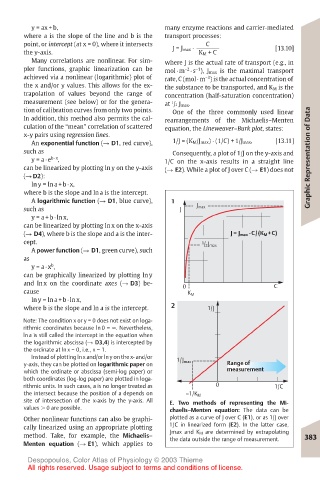
        An exponential function (! D1, red curve),  1/J = (K M/J max) · (1/C) + 1/J max,  [13.11]
      such as                           Consequently, a plot of 1/J on the y-axis and
        y = a · e b · x ,             1/C on the x-axis results in a straight line Graphic Representation of Data
      can be linearized by plotting ln y on the y-axis  (! E2). While a plot of J over C (! E1) does not
      (! D2):
        ln y = ln a + b · x,
      where b is the slope and ln a is the intercept.
        A logarithmic function (! D1, blue curve),  1
      such as                             J  J max
        y = a + b · ln x,
      can be linearized by plotting ln x on the x-axis
      (! D4), where b is the slope and a is the inter-  J = J max  ·C/(K M +C)
      cept.                                   1 / 2 J max
        A power function (! D1, green curve), such
      as
        y = a · x , b
      can be graphically linearized by plotting ln y
      and ln x on the coordinate axes (! D3) be-  0            C
      cause
                                           K M
        ln y = ln a + b · ln x,
      where b is the slope and ln a is the intercept.  2  1/J
      Note: The condition x or y = 0 does not exist on loga-
      rithmic coordinates because ln 0 = '. Nevertheless,
      ln a is still called the intercept in the equation when
      the logarithmic abscissa (! D3,4) is intercepted by
      the ordinate at ln x = 0, i.e., x = 1.
        Instead of plotting ln x and/or ln y on the x- and/or
      y-axis, they can be plotted on logarithmic paper on  1/J max  Range of
      which the ordinate or abscissa (semi-log paper) or  measurement
      both coordinates (log-log paper) are plotted in loga-
      rithmic units. In such cases, a is no longer treated as  0  1/C
      the intersect because the position of a depends on  –1/K M
      site of intersection of the x-axis by the y-axis. All  E. Two methods of representing the Mi-
      values ( 0 are possible.         chaelis–Menten equation: The data can be
      Other nonlinear functions can also be graphi-  plotted as a curve of J over C (E1), or as 1/J over
      cally linearized using an appropriate plotting  1/C in linearized form (E2). In the latter case,
      method. Take, for example, the Michaelis–  Jmax and K M are determined by extrapolating  383
                                       the data outside the range of measurement.
      Menten equation (! E1), which applies to
       Despopoulos, Color Atlas of Physiology © 2003 Thieme
       All rights reserved. Usage subject to terms and conditions of license.

