


Page 1157 - Hall et al (2015) Principles of Critical Care-McGraw-Hill
P. 1157
796     PART 6: Neurologic Disorders


                                                                         The degree of tissue displacement, and therefore a prediction of
                   TABLE 86-4    Herniation Syndromes (Continued)
                                                                       compressed  structures  and  expected  symptoms,  can  be  approximated
                  Herniation   Mechanism/Imaging    Bedside Examination/  by measuring the horizontal shift of the calcified pineal gland on a
                  Syndromes  Findings               Comments           noncontrast head CT. In a classic study describing this important rela-
                  Transdural/   •  Increased ICP forces brain through   •  Sometimes called “brain   tionship, horizontal shift of the pineal gland from its midline position
                  transcranial    dura ± subgaleal extension  fungus”  (eg, Fig. 86-12B) by 0 to 3 mm correlated with wakefulness; 3 to 5 mm
                                                                                                                        28
                  herniation  •  Brain and vessels herniated through  •  Used as therapeutic option   with drowsiness; 6 to 8 mm with stupor; and >8 mm with coma.  In
                              dural ± skull defect    to decompress swollen   comparison, rostrocaudal displacement leads to herniation of brain
                                                      brain (“hemicraniectomy”)  structures through the foramen magnum with resultant pressure on the
                                                    •  Use changes in turgor of   dorsal brainstem and obstruction of CSF outflow providing two mecha-
                                                      “pseudofontanelle” for   nisms for depressed consciousness: direct injury to anatomic structures
                                                      serial bedside examination  responsible for arousal and elevated ICP via hydrocephalus. Midline
                                                    •  Too small craniectomy    shift is often measured as the distance from the falx (midline) to the sep-
                                                      can lead to bleeding and   tum pellucidum and a ratio can be calculated (Figs. 86-12 and 86-13). 29
                                                      brain injury at the bony   Notably, the extent of horizontal shift seen on imaging is not always
                                                      edges            the primary mechanism of a patient’s reduced level of consciousness.
                                                                       Other differential etiologies should always be considered. Further, the
                  Descending Type
                                                                       clinical  sequelae  of  tissue  displacement and  herniation  vary  greatly
                  Central or  •  Both temporal lobes herniate into   •  Impaired consciousness   among patients due to underlying factors that alter reserve and com-
                  bilateral   tentorial opening       with associated    pliance. As an example, an atrophic brain with significantly increased
                  downward   •  Optic chiasm/diencephalon   oculopupillomotor   subarachnoid spaces possesses a greater ability to compensate for tissue
                  transtentorial    compressed against skull base  changes  displacement by decreasing subarachnoid space to maintain a constant
                  herniation  •  Midbrain displaced inferiorly:   •  Progressive loss of all   pressure. As a result, an individual’s reserve factors contributing to
                                anterior inferior third ventricle      brainstem function    compliance must be taken into consideration when assessing the rela-
                              displaced posteriorly behind dorsum;   leading to brain death  tionship between radiographic and clinical presentations in the setting
                              sella angle between midbrain    •  Bilateral flexor or    of intracranial mass lesions and tissue displacement. Some sequelae of
                              and pons becomes more acute   extensor posturing from   herniation are summarized in Table 86-4.
                              (brainstem budding)     progressive brainstem
                             •  Complications:        injury
                               Penetrating basal arteries
                                 occlusion brainstem infarcts
                               and  hemorrhages (Duret)
                               Hydrocephalus
                  Tonsillar  •  Tonsils pushed inferiorly into   •  Common with posterior
                                foramen magnum as displacement   fossa masses
                              >5 mm and tonsil folia become   •  Disturbance of conjugate
                              vertically oriented     gaze, quadriparesis,
                             •  Cisterna magna obliterates    autonomic symptoms
                             •  Complications:        (changes in blood pressure
                               Fourth ventricle outlet obstruction   and heart rate)
                               produces hydrocephalus  •  Miosis and ataxic
                               Compression of medulla produces   breathing
                               changes in respiration    •  Severe and progressive
                               and cardiovascular homeostasis  headache with associated
                                                      nausea and vomiting
                                                    •  Sometimes early
                                                      sign of obstructive
                                                        hydrocephalus
                  Ascending Type
                  Transtentorial  •  Infratentorial mass lesion pushes   •  Less common than
                                cerebellum and upper brainstem     descending herniation
                              upward into the tentorial opening  •  Can be caused by a slowly
                             •  Subsequent narrowing of the  bilateral   growing cerebellar or
                              ambient cisterns as the cerebellar tissue     brainstem process, such
                              extends into the ambient cisterns  as diffusely infiltrating
                             •  Quadrigeminal cistern closed, tectum   astrocytoma
                              flattening            •  Nausea and vomiting are
                             •  Aqueduct obstruction leading to   commonly seen followed
                              obstructive hydrocephalus  by obtundation and coma
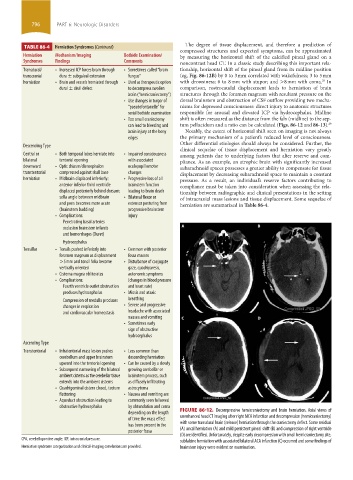
                                                      depending on the length   FIGURE 86-12.  Decompressive hemicraniectomy and brain herniation. Axial views of
                                                      of time the mass effect   unenhanced head CT imaging after right MCA infarction and decompression (hemicraniectomy)
                                                      has been present in the   with some transdural brain (release) herniation through the craniectomy defect. Some residual
                                                      posterior fossa  (A) uncal herniation (A) and mild persistent pineal shift (B) and compression of right ventricle
                                                                       (D) are identified. Unfortunately, despite early decompression with small hemicraniectomy site,
                 CPA, cerebellopontine angle; ICP, intracranial pressure.  subfalcine herniation with associated bilateral ACA infarction (C) occurred and some findings of
                 Herniation syndrome categorization and clinical-imaging correlations are provided.  brainstem injury were evident on examination.


            section06.indd   796                                                                                       1/23/2015   12:55:54 PM

