


Page 1158 - Hall et al (2015) Principles of Critical Care-McGraw-Hill
P. 1158
CHAPTER 86: Intracranial Pressure: Monitoring and Management  797


                                                                          from a medially displaced uncus, which subsequently evolves to stupor,
                                                                          coma, and contralateral pupil dilation from further brainstem compres-
                                                                          sion if the source of the herniation is not corrected. Pupillary changes can
                                                                          reverse with successful, rapid ICP normalization. Uncal herniation can
                                                                          result in trapping of the ipsilateral temporal horn of the lateral ventricle
                                                                          with resultant CSF obstruction, dilation of the temporal horn and sur-
                                                                          rounding tissue (Fig. 86-12).
                                                                           Central transtentorial herniation (Fig. 86-11-2) is most common with
                                                                          global, bihemispheric processes (eg, global ischemia/infarction, menin-
                                                                          gitis, or fulminant hepatic failure) and it classically occurs as the cerebral
                                                                          hemispheres and basal ganglia exert downward pressure, causing brain
                                                                          displacement through the tentorial incisura bilaterally with the pressure
                                                                          cone into the brainstem. If progressive, it results in severe brainstem
                                                                          compression and ischemia with hemorrhage. Bilateral PCA compression
                                                                          can occur with resulting ischemia of the PCA territories as well as the
                                                                          potential for CSF outflow obstruction with hydrocephalus.
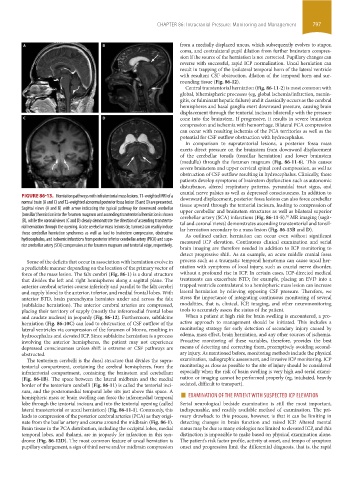
                                                                           In comparison to supratentorial lesions, a posterior fossa mass
                                                                          exerts direct pressure on the brainstem from downward displacement
                                                                          of the cerebellar tonsils (tonsillar herniation) and lower brainstem
                                                                          (medulla) through the foramen magnum (Fig. 86-11-6). This causes
                                                                          severe brainstem and upper cervical spinal cord compression, as well as
                                                                          obstruction of CSF outflow resulting in hydrocephalus. Clinically, these
                                                                          patients develop symptoms of brainstem dysfunction such as autonomic
                                                                          disturbance, altered respiratory patterns, pyramidal tract signs, and
                                                                          cranial nerve palsies as well as depressed consciousness. In addition to
                    FIGURE 86-13.  Herniation pathways with infratentorial mass lesions. T1-weighted MRI of a   downward displacement, posterior fossa lesions can also force cerebellar
                    normal brain (A and C) and T2-weighted abnormal posterior fossa lesion (B and D) are presented.   tissue upward through the tentorial incisura, leading to compression of
                    Sagittal views (A and B) with arrow indicating the typical pathway for downward cerebellar   upper cerebellar and brainstem structures as well as bilateral superior
                    (tonsillar) herniation into the foramen magnum and ascending transtentorial herniation is shown   cerebellar artery (SCA) infarctions (Fig. 86-11-5).  MR imaging (sagit-
                                                                                                              30
                    (B), while the coronal views (C and D) clearly demonstrate the direction of ascending transtento-  tal and coronal views) demonstrates ascending transtentorial and tonsil-
                    rial herniation through the opening. Acute cerebellar mass lesions (ie, tumors) can readily induce   lar herniation secondary to a mass lesion (Fig. 86-13B and D).
                    these cerebellar herniation syndromes as well as lead to brainstem compression, obstructive   As  outlined  earlier,  herniation can  occur  even  without  significant
                    hydrocephalus, and ischemic infarctions from posterior inferior cerebellar artery (PICA) and supe-  measured ICP elevation. Continuous clinical examination and serial
                    rior cerebellar artery (SCA) compression at the foramen magnum and tentorial edge, respectively.
                                                                          brain imaging are therefore needed in addition to ICP monitoring to
                                                                          detect progressive shift. As an example, an acute middle cranial fossa
                     Some of the deficits that occur in association with herniation evolve in   process such as a traumatic temporal hematoma can cause uncal her-
                    a predictable manner depending on the location of the primary vector of   niation with symptoms of local injury, such as cranial nerve disorder,
                    force of the mass lesion. The falx cerebri (Fig. 86-1) is a dural structure   without a profound rise in ICP. In certain cases, ICP-directed medical
                    that divides the left and right hemispheres along a sagittal plane. The   treatments can exacerbate BTD; for example, placing an EVD into a
                    anterior cerebral arteries course inferiorly and parallel to the falx cerebri   trapped ventricle contralateral to a hemispheric mass lesion can increase
                    and supply blood to the anterior, inferior, and medial frontal lobes. With   lateral herniation by relieving opposing CSF pressure. Therefore, we
                    anterior BTD, brain parenchyma herniates under and across the falx   stress the importance of integrating continuous monitoring of several
                    (subfalcine herniation). The anterior cerebral arteries are compressed,   modalities, that is, clinical, ICP, imaging, and other neuromonitoring
                    placing their territory of supply (mostly the inferomedial frontal lobes   tools to accurately assess the status of the patient.
                    and caudate nucleus) in jeopardy (Fig. 86-12). Furthermore, subfalcine   When a patient at high risk for brain swelling is encountered, a pro-
                    herniation (Fig. 86-10C) can lead to obstruction of CSF outflow of the   active approach to management should be initiated.  This  includes a
                    lateral ventricles via compression of the foramen of Monro, resulting in     monitoring strategy for early detection of secondary injury caused by
                    hydrocephalus and elevated ICP. Since subfalcine herniation is a process   edema, mass effect, brain herniation, and any other sources of ischemia.
                    involving the anterior hemispheres, the patient may not experience   Proactive monitoring of these variables, therefore, provides the best
                    depressed consciousness unless shift is  extreme or  CSF pathways  are   means of detecting and correcting them, preemptively avoiding second-
                    obstructed.                                           ary injury. As mentioned before, monitoring methods include the  physical
                     The tentorium cerebelli is the dural structure that divides the supra-  examination, radiographic assessment, and invasive ICP monitoring. ICP
                    tentorial compartment, containing the cerebral hemispheres, from the   monitoring as close as possible to the site of injury should be considered
                    infratentorial compartment, containing the brainstem and cerebellum   especially when the risk of brain swelling is very high and serial exami-
                    (Fig. 86-1B). The space between the lateral midbrain and the medial   nation or imaging cannot be performed properly (eg, intubated, heavily
                      border of the tentorium cerebelli (Fig. 86-11) is called the tentorial inci-  sedated, difficult to transport).
                    hemispheric mass or brain swelling can force the inferomedial temporal   ■  EXAMINATION OF THE PATIENT WITH SUSPECTED ICP ELEVATION
                    sura, and the posteromedial temporal lobe sits just above this space. A
                    lobe through the tentorial incisura and into the tentorial opening (called   Serial neurological bedside examination is still the most important,
                    lateral transtentorial or uncal herniation) (Fig. 86-11-1). Commonly, this   indispensable, and readily available method of examination. The pri-
                    leads to compression of the posterior cerebral arteries (PCA) as they origi-  mary drawback to this process, however, is that it can be limiting in
                    nate from the basilar artery and course around the midbrain (Fig. 86-1).   detecting changes in brain function and raised ICP. Altered mental
                    Brain tissue in the PCA distribution, including the occipital lobes, medial     status may be due to many etiologies not limited to elevated ICP, and this
                    temporal lobes, and thalami, are in jeopardy for infarction in this syn-  distinction is impossible to make based on physical examination alone.
                    drome (Fig. 86-12D). The most common feature of uncal herniation is   The patient’s risk factor profile, activity at onset, and tempo of symptom
                    pupillary enlargement, a sign of third nerve and/or midbrain compression   onset and progression limit the differential diagnosis, that is, the rapid


            section06.indd   797                                                                                       1/23/2015   12:55:55 PM

