


Page 111 - Hall et al (2015) Principles of Critical Care-McGraw-Hill
P. 111
CHAPTER 12: Rapid Response Teams  79


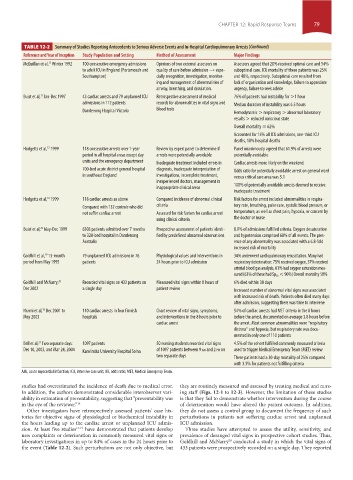
                      TABLE 12-2    Summary of Studies Reporting Antecedents to Serious Adverse Events and In-Hospital Cardiopulmonary Arrests (Continued)
                    Reference and Year of Inception   Study Population and Setting  Method of Assessment  Major Findings
                    McQuillan et al,  Winter 1992  100 consecutive emergency admissions   Opinions of two external assessors on   Assessors agreed that 20% received optimal care and 54%
                             13
                                        to adult ICU in England (Portsmouth and   quality of care before admission → espe-  suboptimal care. ICU mortality of these patients was 25%
                                        Southampton)              cially recognition, investigation, monitor-  and 48%, respectively. Suboptimal care resulted from
                                                                  ing and management of abnormalities of   lack of organization and knowledge, failure to appreciate
                                                                  airway, breathing, and circulation.  urgency, failure to seek advice
                          17
                    Buist et al,  Jan-Dec 1997  43 cardiac arrests and 79 unplanned ICU   Retrospective assessment of medical   76% of patients had instability for >1 hour
                                        admissions in 112 patients  records for abnormalities in vital signs and   Median duration of instability was 6.5 hours
                                        Dandenong Hospital Victoria  blood tests            Hemodynamic > respiratory > abnormal laboratory
                                                                                            results > reduced conscious state
                                                                                            Overall mortality = 62%
                                                                                            Accounted for 15% all ICU admissions, one-third ICU
                                                                                            deaths, 18% hospital deaths
                            12
                    Hodgetts et al,  1999  118 consecutive arrests over 1-year   Review by expert panel to determine if   Panel unanimously agreed that 61.9% of arrests were
                                        period in all hospital areas except day   arrests were potentially avoidable  potentially avoidable
                                        units and the emergency department  Inadequate treatment included errors in   Cardiac arrests more likely on the weekend
                                        700-bed acute district general hospital   diagnosis, inadequate interpretation of   Odds ratio for potentially avoidable arrest on general ward
                                        in southeast England      investigations, incomplete treatment,   versus critical care area was 5.1
                                                                  inexperienced doctors, management in
                                                                  inappropriate clinical areas  100% of potentially avoidable arrests deemed to receive
                                                                                            inadequate treatment
                    Hodgetts et al,  1999  118 cardiac arrests as above  Compared incidence of abnormal clinical   Risk factors for arrest included abnormalities in respira-
                            16
                                        Compared with 132 controls who did   criteria       tory rate, breathing, pulse rate, systolic blood pressure, or
                                        not suffer cardiac arrest  Assessed for risk factors for cardiac arrest   temperature, as well as chest pain, hypoxia, or concern by
                                                                  using clinical criteria   the doctor or nurse
                    Buist et al,  May-Dec 1999  6303 patients admitted over 7 months   Prospective assessment of patients identi-  8.9% of admissions fulfilled criteria. Oxygen desaturation
                          22
                                        to 320-bed hospital in Dandenong   fied by predefined abnormal observations   and hypotension comprised 68% of all events. The pres-
                                        Australia                                           ence of any abnormality was associated with a 6.8-fold
                                                                                            increased risk of mortality
                            19
                    Goldhill et al,  13-month   79 unplanned ICU admissions in 76   Physiological values and interventions in    34% underwent cardiopulmonary resuscitation. Many had
                    period from May 1995  patients                24 hours prior to ICU admission  respiratory deterioration: 75% received oxygen, 37% received
                                                                                            arterial blood gas analysis, 61% had oxygen saturation mea-
                                                                                                            < 90%) Overall mortality 58%
                                                                                            sured (63% of these had Sp O 2
                    Goldhill and McNarry,    Recorded vital signs on 433 patients on   Measured vital signs within 8 hours of    6% died within 30 days
                                20
                    Dec 2002            a single day              patient review            Increased number of abnormal vital signs was associated
                                                                                            with increased risk of death. Patients often died many days
                                                                                            after admission, suggesting there was time to intervene
                    Nurmi et al,  Dec 2001 to    110 cardiac arrests in four Finnish   Chart review of vital signs, symptoms,    54% of cardiac arrests had MET criteria in the 8 hours
                           18
                    May 2003            hospitals                 and interventions in the 8 hours prior to   before the arrest, documented on average 3.8 hours before
                                                                  cardiac arrest            the arrest. Most common abnormalities were “respiratory
                                                                                            distress” and hypoxia, but respiratory rate was docu-
                                                                                            mented in only one of 110 patients
                         21
                    Bell et al,  Two separate days:    1097 patients  50 nursing students recorded vital signs   4.5% of the cohort fulfilled commonly measured criteria
                    Dec 10, 2003, and Mar 24, 2004  Karolinska University Hospital Solna  of 1097 patients between 9 am and 2 pm on   used to trigger Medical Emergency Team (MET) review
                                                                  two separate days         These patients had a 30-day mortality of 25% compared
                                                                                            with 3.5% for patients not fulfilling criteria
                    AMI, acute myocardial infarction; ICU, intensive care unit; OR, odds ratio; MET, Medical Emergency Team.

                    studies had overestimated the incidence of death due to medical error.   they are routinely measured and assessed by treating medical and nurs-
                    In addition, the authors demonstrated considerable interobserver vari-  ing staff (Figs. 12-1 to 12-3). However, the limitation of these studies
                    ability in estimation of preventability, suggesting that “preventability was   is that they fail to demonstrate whether intervention during the course
                    in the eye of the reviewer.” 14                       of deterioration would have altered the patient outcome. In addition,
                     Other investigators have retrospectively assessed patients’ case his-  they do not assess a control group to document the frequency of such
                    tories for objective signs of physiological or biochemical instability in   perturbations  in  patients  not  suffering  cardiac  arrest  and  unplanned
                    the hours leading up to the cardiac arrest or unplanned ICU admis-  ICU admission.
                    sion. At least five studies 15-19  have demonstrated that patients develop   Three  studies  have attempted to assess the  utility, sensitivity, and
                    new complaints or deterioration in commonly measured vital signs or   prevalence of deranged vital signs in prospective cohort studies. Thus,
                    laboratory investigations in up to 84% of cases in the 24 hours prior to     Goldhill and McNarry  conducted a study in which the vital signs of
                                                                                          20
                    the event (Table 12-2). Such perturbations are not only objective, but   433 patients were prospectively recorded on a single day. They reported


            Section01.indd   79                                                                                        1/22/2015   9:37:17 AM

